

Machine Learning Secrets Behind Smart Apps and AI
Machine Learning Secrets Behind Smart Apps explain how modern applications use data, algorithms, and intelligent models to deliver personalized and predictive user experiences.
Table of Contents
Introduction: The Hidden Intelligence Powering Smart Apps and AI
Machine Learning Secrets Behind Smart Apps reveal how modern applications quietly learn, adapt, and respond with uncanny precision. Smart applications rarely announce their intelligence. They simply work. They anticipate needs, adapt to preferences, and respond with accuracy.
This apparent effortlessness is the result of Machine Learning basics operating silently beneath the interface, transforming ordinary software into responsive, predictive systems. This section serves as a clear Machine Learning introduction and Machine Learning overview for modern digital products.
Modern apps feel intuitive because they learn continuously. Every interaction refines behavior. Every signal improves relevance. Understanding what is Machine Learning explains why it has become the invisible infrastructure powering everyday digital experiences, from navigation and entertainment to productivity and communication.
What Makes Smart Apps Intelligent Using Machine Learning Secrets
Intelligence in software is not defined by flashy features or complex interfaces. It is defined by adaptability, which lies at the core of essential Machine Learning concepts. A truly smart system can observe, learn, and evolve based on new information.
Traditional applications rely on static rules. Smart systems replace rigidity with learning through proven Machine Learning methods and Machine Learning techniques. Data-driven decision-making allows applications to adjust behavior dynamically, optimizing outcomes as conditions change.
Core Machine Learning Foundations Behind Smart Apps
Data is the raw material of intelligence. Without data, even the most advanced Machine Learning algorithms remain inactive. In smart applications, data captures behavior, context, and outcomes, forming the foundation for Supervised Machine Learning, Unsupervised Machine Learning, and Reinforcement Machine Learning.
Features represent measurable signals. Labels define desired results. Learning signals guide Machine Learning optimization and improve Machine Learning accuracy. Clean, relevant data consistently produces stronger Machine Learning models than large but unreliable datasets.
Learning From Users: The Secret Feedback Loop
User behavior is a constant stream of instruction. Every click, swipe, pause, and search communicates intent and fuels real-world Machine Learning applications.
This feedback loop is continuous. Systems refine predictions using practical Machine Learning use cases that convert interaction data into smarter digital experiences, improving relevance across platforms.
Algorithms That Power Intelligent Experiences
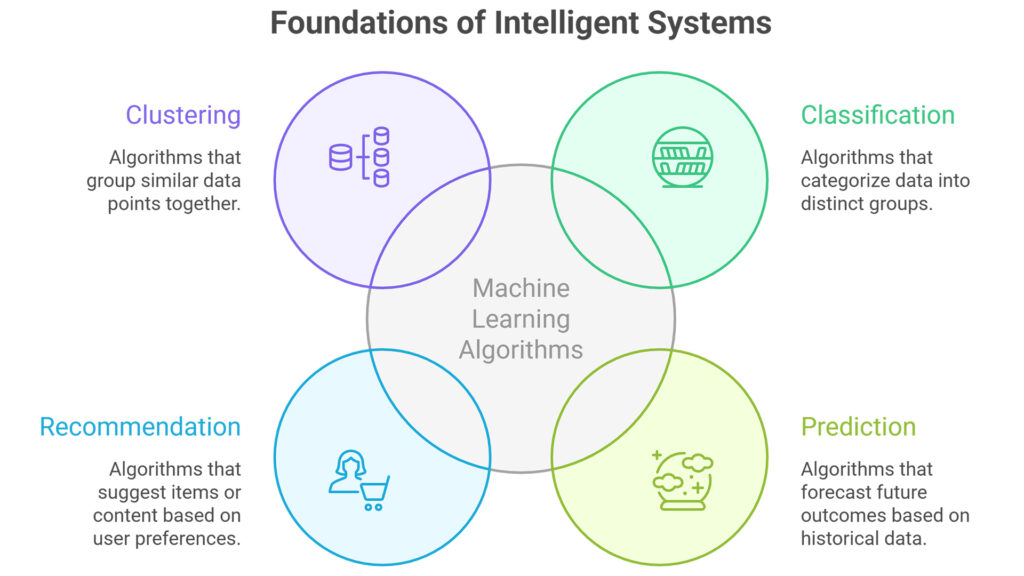
Algorithms are the decision engines behind smart applications. Classification, prediction, and recommendation systems are foundational Machine Learning algorithms used across industries.
Clustering enables personalization at scale, while predictive models influence outcomes in Machine Learning in business, Machine Learning in finance, and consumer platforms. Choosing the right algorithm directly impacts performance, fairness, and reliability.
Models That Remember and Improve Over Time
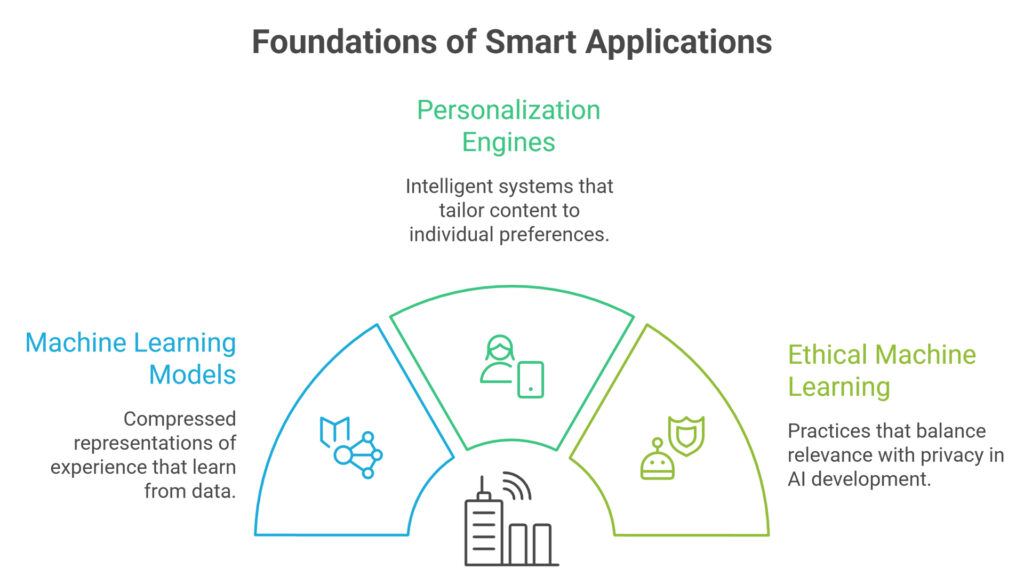
A Machine Learning model is a compressed representation of experience. It stores patterns learned from historical data, enabling accurate inference on new inputs.
Training builds intelligence. Inference delivers value. Continuous updates ensure models remain relevant, accurate, and aligned with changing user behavior.
Personalization Engines Inside Smart Applications
Personalization is one of the most visible results of Machine Learning Secrets Behind Smart Apps. Intelligent systems tailor content using advanced Machine Learning techniques that adapt to individual preferences.
Smart design balances relevance with privacy, applying ethical Machine Learning practices to deliver contextual awareness without overreach.Personalization Engines Inside Smart Applications Using Machine Learning Secrets Behind Smart Apps
Behind the Scenes of AI-Powered Features
Speech recognition, natural language understanding, and image recognition rely on Deep Learning vs Machine Learning architectures working together.
Conversational AI, chatbots, and virtual assistants demonstrate applied intelligence powered by scalable models trained using modern Machine Learning frameworks and Machine Learning libraries.
From Data to Decisions: The Smart App Pipeline
Data flows through structured pipelines supported by robust Machine Learning software and cloud platforms. Preprocessing, feature engineering, training, and deployment are critical stages.
Real-time inference and batch processing are optimized using Python for Machine Learning and industry-standard Machine Learning tools.
Edge AI and On-Device Intelligence
Edge AI brings intelligence closer to users. On-device learning reduces latency, improves privacy, and extends Machine Learning applications to offline environments.
This shift enhances trust and performance without sacrificing capability.
Ethical Design in Smart Apps and AI
Responsible intelligence is essential. Ethical systems reduce bias and prioritize transparency through explainable Machine Learning models.
Trust grows when users understand how decisions are made and why outcomes occur.
Scaling Machine Learning for Millions of Users
Growth demands resilient systems. Continuous monitoring ensures sustained Machine Learning accuracy, while drift detection maintains relevance at scale.
Operational excellence is just as important as algorithmic strength.
Future Innovations in Smart Apps and AI
Multimodal intelligence will shape the next era of technology. Autonomous systems will combine text, vision, and context to deliver richer and more human-like experiences.
As platforms evolve, Machine Learning applications will become more proactive, adaptive, and collaborative.
Conclusion: Unlocking the Secrets Behind Intelligent Technology
Machine Learning Secrets Behind Smart Apps form the silent engine behind modern smart apps and AI. They power everything from personalization to prediction.
For learners seeking a Machine Learning tutorial, Machine Learning course, or Machine Learning training, platforms that help Learn Machine Learning online provide strong foundations. Machine Learning for beginners opens pathways to Machine Learning jobs, a clear Machine Learning career path, and roles such as Machine Learning Engineer. With the right Machine Learning skills, competitive Machine Learning salary opportunities emerge across industries. Institutions like VNET Academy support this journey from fundamentals to professional mastery.
What are Machine Learning Secrets Behind Smart Apps?
Machine Learning Secrets Behind Smart Apps refer to the hidden algorithms, data models, and learning techniques that enable applications to understand user behavior, adapt in real time, and deliver intelligent, personalized experiences without manual programming.
What types of machine learning are used in smart applications?
Most smart applications rely on Supervised Machine Learning, Unsupervised Machine Learning, and Reinforcement Learning. These methods help apps classify data, discover patterns, and continuously improve decisions based on feedback.
Why is ethical machine learning important for smart apps?
Ethical machine learning ensures fairness, transparency, and privacy. Smart apps must minimize bias and explain decisions clearly so users can trust AI-powered systems.