
Cloud and DevOps Best Practices for Teams
Cloud and DevOps Best Practices for Teams define how modern organizations achieve speed, resilience, and continuous delivery in a cloud-driven era.
Table of Contents
Introduction: Evolving Teams for a Cloud-Driven Era
Cloud and DevOps Best Practices for Teams have become essential in a cloud-driven era where speed, resilience, and continuous delivery define success. The velocity of digital transformation has reshaped how modern teams operate. Traditional boundaries between development, operations, security, and infrastructure have dissolved, giving way to integrated ecosystems capable of delivering rapid, high-quality innovation.
Organizations no longer compete solely on product features—they compete on speed, experience, and resilience. Cloud computing and DevOps methodologies form the backbone of this new operational paradigm. Learn more about cloud and DevOps best practices in our DevOps training guide.. When combined, they enable teams to transcend siloed workflows and build an environment where automation, experimentation, and continuous delivery become the norm.
Understanding the Foundations of Cloud and DevOps Best Practices
Defining cloud-native principles that empower agility
Cloud-native principles encourage teams to build applications that fully leverage the scalability, elasticity, and distributed nature of the cloud. These principles emphasize modular design, stateless services, and dynamic resource allocation. By adopting cloud-native DevOps practices, teams gain the ability to iterate quickly, deploy frequently, and recover gracefully from failures.
Core DevOps values: collaboration, automation, and continuous improvement
DevOps best practices for teams focus on cultural alignment as much as technical excellence. Collaboration eliminates friction across roles, automation reduces repetitive work and human error, and continuous improvement ensures systems evolve alongside business needs.
Building a High-Performance Cloud DevOps Culture
Fostering cross-functional collaboration across teams
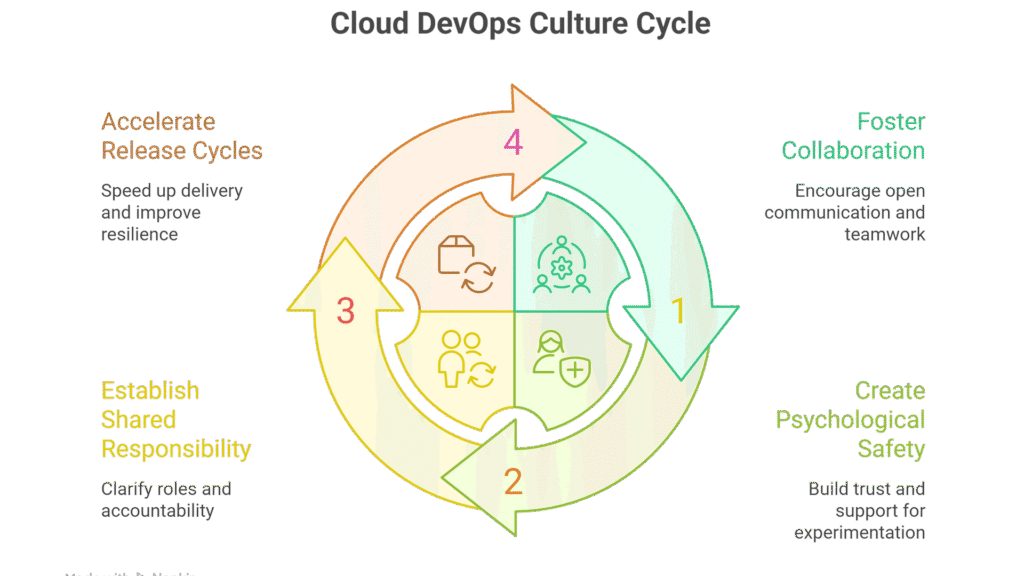
High-performing teams following Cloud and DevOps Best Practices for Teams prioritize open communication. Developers, QA engineers, operations teams, and security professionals collaborate through shared dashboards, stand-ups, and design reviews—accelerating delivery and reducing risk.
Creating psychological safety to support experimentation and learning
Psychological safety enables experimentation without fear. When teams feel safe to fail and learn, innovation thrives and systems improve continuously. These principles strengthen Cloud and DevOps Best Practices for Teams by improving collaboration, speed, and system reliability.
Establishing a Shared Responsibility Model in Cloud DevOps
Clarifying ownership across development, operations, and security
A shared responsibility model is a core DevOps best practice. Development teams own application logic, operations teams manage performance and uptime, and security teams ensure compliance. Alignment across these roles strengthens reliability.
How shared accountability accelerates release cycles
When responsibility is shared, handoff delays disappear. This speeds up releases and improves overall system resilience.
Choosing the Right Cloud Architecture for Team Needs
Monolithic vs. microservices architecture
Monolithic systems offer simplicity, while microservices—commonly used in cloud-native DevOps—enable independent deployment and scalability. The right choice depends on team maturity and long-term goals.
Cloud-native design patterns for resilience
Patterns such as circuit breakers, bulkheads, and service meshes help teams build fault-tolerant systems capable of handling failures gracefully.
Implementing Infrastructure as Code as a DevOps Best Practice
Why Infrastructure as Code improves consistency
Infrastructure as Code (IaC) is a foundational cloud DevOps best practice that eliminates configuration drift, accelerates provisioning, and ensures repeatable environments.To explore this further, read our complete guide on Infrastructure as Code best practices.
Best IaC tools for cloud teams
Terraform, AWS CloudFormation, Azure Bicep, and Ansible enable teams to manage infrastructure using version-controlled, declarative configurations.
Automating CI/CD Pipelines for Cloud DevOps Teams
Building a seamless CI/CD workflow
CI/CD pipelines automate testing, integration, and deployment—making them a core component of cloud and DevOps best practices for teams.
Automation techniques that reduce human error
Automated testing, policy checks, and deployment scripts improve reliability and productivity across the software lifecycle.
Version Control Best Practices for Cloud DevOps Teams
Branching strategies that support continuous integration
Trunk-based development, GitFlow, and feature branching help teams collaborate efficiently while maintaining code stability.
Maintaining code quality through reviews
Structured code reviews promote knowledge sharing and long-term maintainability.
Adopting Containerization to Improve Portability
How containers support cloud-native DevOps
Containers ensure applications run consistently across development, testing, and production environments.
Container security and image best practices
Using lightweight images, proper tagging, and vulnerability scanning strengthens container security.
Leveraging Kubernetes for Scalable Cloud Operations
Automated scaling and self-healing infrastructure
Kubernetes enables automated scaling, load balancing, and self-healing—key advantages of cloud-native DevOps practices.Kubernetes provides automated scaling and self-healing capabilities, as explained in the official Kubernetes documentation.
Optimizing clusters for cost and performance
Efficient resource limits and autoscaling reduce costs without sacrificing performance.
Enhancing Observability in Cloud DevOps Environments
Monitoring performance and system health
Real-time dashboards and alerts help teams detect and resolve issues proactively.
Logs, metrics, and traces
Together, these elements form a complete observability stack essential for modern cloud systems.
Incident Management as a DevOps Best Practice
Runbooks and on-call strategies
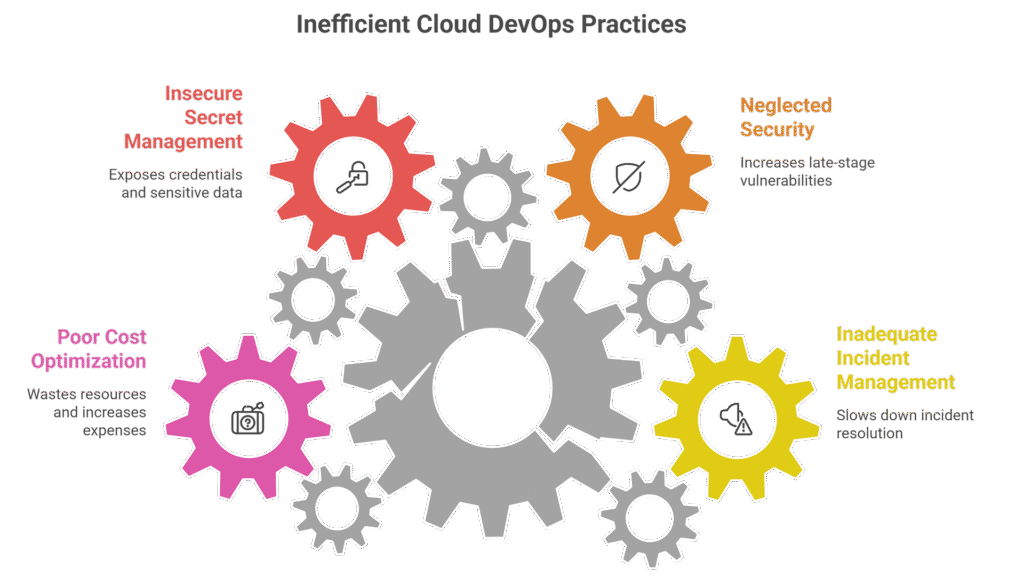
Prepared runbooks and effective on-call rotations ensure rapid incident resolution.
Blameless post-incident reviews
Retrospectives focus on learning and system improvement rather than blame.
Security Embedded Through DevSecOps Practices
Shifting security left
DevSecOps integrates security into every stage of development, reducing late-stage vulnerabilities.
Automated security scanning
Continuous scanning of code, dependencies, and container images protects cloud environments.
Managing Secrets and Sensitive Configuration Securely
Secure storage and rotation
Secrets managers and encryption protect credentials and sensitive data.
Cloud-native security tools
AWS Secrets Manager, Azure Key Vault, and HashiCorp Vault enforce access control and auditing.
Optimizing Cloud Costs Using DevOps Strategies
Rightsizing workloads
Analyzing usage patterns helps eliminate wasted resources.
Auto-scaling and cost dashboards
These tools enable proactive cost optimization without impacting performance.
Enhancing Collaboration with DevOps Toolchains
Integrated toolchains align communication, deployment, monitoring, and analytics—improving visibility and coordination.
Promoting Continuous Learning in Cloud DevOps Teams
Upskilling through certifications, workshops, and internal knowledge sharing sustains long-term excellence.
Governance and Compliance in Cloud DevOps
Automated policies and audit-ready processes ensure compliance without slowing innovation.
Integrating AI and Automation into DevOps Workflows
AI-driven insights help predict failures, optimize pipelines, and enable self-healing systems.
Measuring Success with DevOps Metrics
DORA metrics
Deployment frequency, lead time, change failure rate, and MTTR validate DevOps maturity, as defined by Google’s DevOps Research and Assessment (DORA).
Data-driven improvement
Metrics guide targeted optimizations and continuous improvement.
Case Studies of Successful Cloud DevOps Teams
Organizations adopting cloud and DevOps best practices for teams achieve faster deployments, higher reliability, and lower operational costs.
Conclusion: Powering High-Velocity Teams Through Cloud and DevOps Excellence
In a rapidly evolving digital landscape, static systems cannot compete. By adopting Cloud and DevOps Best Practices for Teams, organizations enable faster delivery, stronger security, optimized costs, and scalable growth. Embracing cloud-native architecture, DevOps culture, and automation builds a foundation for long-term digital success.Organizations aiming to scale faster can also explore our cloud DevOps implementation guide.