
Flask vs Django for Beginners: Uncover the Best Framework
Introduction
When starting with Python web development, one of the first questions beginners ask is: Flask vs Django for beginners — which framework should I choose?
Both Flask and Django are powerful and widely used Python web frameworks. However, they are designed with different philosophies and use cases in mind. Choosing the right one at the beginning can significantly impact how easily you understand web development concepts and how quickly you can build applications . At Vnet Academy, we provide step-by-step tutorials on Flask and Django to help beginners get started.”
In this article, we will explore the differences between Flask vs Django for beginners in a clear and beginner-friendly way. By the end, you will have a solid understanding of which framework is better suited for your needs.
What is Flask?
Flask is a lightweight Python web framework that provides the essential tools needed to build web applications. It is often referred to as a “micro-framework” because it keeps things simple and does not include many built-in features.
With Flask, developers have the freedom to choose how they structure their application, which libraries they use, and how they implement features such as authentication or database integration.
For beginners, Flask is a great starting point because it allows you to learn the core concepts of web development, such as routing, request handling, and APIs, without overwhelming complexity. You can explore our detailed Flask tutorials at Vnet Academy for hands-on learning.”
What is Django?
Django is a full-stack Python web framework that follows a “batteries-included” approach. This means it comes with a wide range of built-in features such as an admin panel, authentication system, and database management. Read the Django Official Documentation to explore all features in detail.
Django enforces a structured way of building applications, which helps maintain consistency and scalability, especially in larger projects.
For beginners, Django can feel complex at first due to its many features. However, it is highly efficient when building complete applications quickly.
Once you are comfortable, you can move to Django to take advantage of its powerful features and structured environment. For a smooth learning experience, explore our Django courses at Vnet Academy designed specifically for beginners
Flask vs Django for Beginners: Key Differences
1. Learning Curve
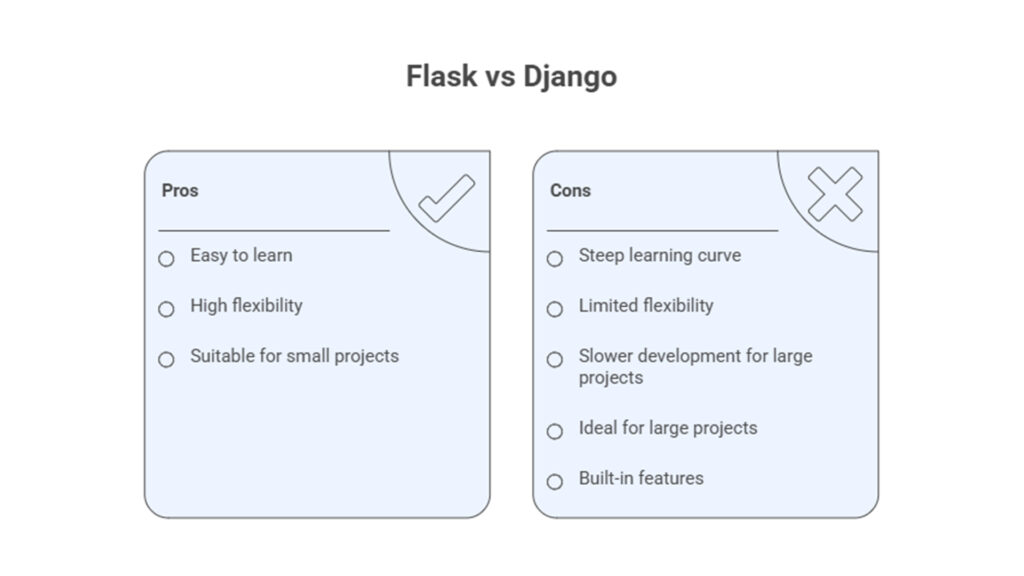
Flask is easier to learn because it has a minimal setup and fewer concepts to understand initially. Beginners can start building simple applications quickly.
Django, on the other hand, has a steeper learning curve because of its built-in features and structured approach.
For beginners who want a smooth introduction, Flask is generally the better option.
2. Flexibility
Flask offers high flexibility. Developers can choose their own tools and design the application structure as they prefer.
Django follows a predefined structure, which limits flexibility but ensures consistency and best practices.
If you prefer control and customization, Flask is more suitable.
3. Development Speed
Flask requires developers to build many components manually, which can slow down development for larger applications.
Django speeds up development by providing ready-to-use features such as authentication and database handling.
For building complete applications quickly, Django has the advantage.
4. Project Size and Use Case
Flask is best suited for:
- Small to medium-sized applications
- APIs and microservices
- Learning projects
Django is ideal for:
- Large-scale applications
- Business and enterprise solutions
- Applications that require built-in features
5. Built-in Features
Flask provides only the essentials, allowing developers to add additional features as needed.
Django includes many built-in features, such as:
- User authentication
- Admin dashboard
- Object-relational mapping (ORM)
- Security features
Django is more suitable when you need a complete solution out of the box.
Which One Should Beginners Choose?
The choice between Flask vs Django for beginners depends on your goals as a beginner.
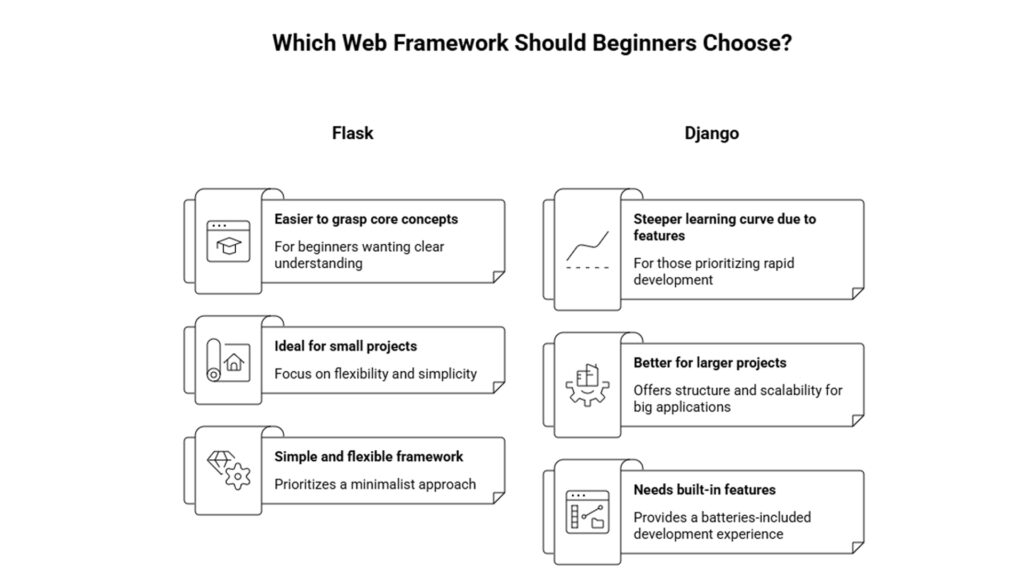
Choose Flask if:
- You are new to web development
- You want to understand core concepts clearly
- You prefer a simple and flexible framework
- You are working on small projects
Choose Django if:
- You want to build applications quickly
- You need built-in features
- You are working on larger projects
- You prefer a structured development approach
Recommended Learning Path
For most beginners, the best approach is to start with Flask. It helps you build a strong foundation in web development concepts.
Once you are comfortable, you can move to Django to take advantage of its powerful features and structured environment.
This combination gives you both conceptual clarity and practical development skills. If you want to strengthen your Python skills before diving deep into Flask vs Django for beginners , refer to the Python Official Tutorial.
Conclusion
In the comparison of Flask vs Django for beginners , there is no single correct answer. Both frameworks are valuable and widely used in the industry.
Flask is simple, flexible, and ideal for learning. Django is powerful, structured, and suitable for building complete applications quickly.
Flask vs Django for beginners , starting with Flask and then transitioning to Django is often the most effective path. Ultimately, the key to learning is consistent practice and building real-world projects.
What is the difference between Flask and Django for beginners?
Flask is a lightweight, flexible Python web framework, while Django is a full-featured, structured framework. Beginners often start with Flask for simplicity and move to Django for larger projects.
Should beginners start with Flask or Django?
Beginners usually start with Flask to understand core web development concepts. Once comfortable, transitioning to Django allows building scalable applications efficiently.
Which Python web framework is easier for beginners: Flask or Django?
Flask has a gentler learning curve, making it ideal for beginners. Django can feel complex initially but is efficient for building complete applications once learned.
Which types of projects are best for Flask vs Django for beginners?
Flask is best for learning projects, microservices, and small to medium applications. Django is suited for enterprise solutions, large-scale apps, and projects requiring built-in features.