
logotype
  • Home
  • About us
  • Courses
    • Software Programming
      • Python
      • C Programming
      • C++ Programming
      • Dot Net
      • JAVA
      • Java Script
      • Node Js
      • Angular
      • React Js
      • Spring Boot
    • Web Development
      • Dot Net Full Stack
      • Front Full Stack
      • Java Full Stack
      • Mean Stack
      • Mern Stack
      • Mobile App Development
      • PHP Full Stack
      • Python Full Stack
    • Digital Marketing
      • Digital Marketing
    • Cloud Computing
      • AWS
      • Azure
      • Cloud Computing
      • DevOps
      • Linux
    • Designing
      • coreIDRAW
      • Graphic Designing
      • Illustrator
      • IN Design
      • Photoshop
      • UI UX Design
    • Software Testing
      • Automation Selenium Testing
      • Manual Testing
      • Software Testing
    • Data science
      • Big Data Hadoop
      • Blockchain
      • NLTK
      • Numpy
      • Keras
      • Matplotlib
      • Pandas
      • Python
      • Tableau
      • TensorFlow
    • Data Analyst
      • Advanced Excel
      • MySQL
      • Power BI
      • Python
    • Business Analyst
      • Advanced Excel
      • Ms Excel
      • MySQL
      • Power BI
    • Ms office
      • Advanced Excel
      • Ms Access
      • Ms Excel
      • Ms Outlook
      • Ms Powerpoint
      • Ms Word
    • Database
      • Microsoft SQL
      • Mongo DB
      • MySQL
    • Hardware & Networking
      • CCNA
      • CCNP
      • Hardware & Networking
      • Linux
  • Official Partners
    • Edureka IT Training
      • Cloud and Devops in Edureka
      • Cyber security in Edureka
      • Data science in Edureka
      • Full Stack in Edureka
      • Power Bi Edureka
      • Software Testing Edureka
    • Tally Education ( TEPL )
      • Tally
      • Tally Level 1
      • Tally Level 2
      • Tally Level 3
      • Tally Comprehensive
      • Pay Roll
  • Blogs
  • Contact us
  • University Degrees
  • GALLERY
logotype
  • Home
  • About us
  • Courses
    • Software Programming
      • Python
      • C Programming
      • C++ Programming
      • Dot Net
      • JAVA
      • Java Script
      • Node Js
      • Angular
      • React Js
      • Spring Boot
    • Web Development
      • Dot Net Full Stack
      • Front Full Stack
      • Java Full Stack
      • Mean Stack
      • Mern Stack
      • Mobile App Development
      • PHP Full Stack
      • Python Full Stack
    • Digital Marketing
      • Digital Marketing
    • Cloud Computing
      • AWS
      • Azure
      • Cloud Computing
      • DevOps
      • Linux
    • Designing
      • coreIDRAW
      • Graphic Designing
      • Illustrator
      • IN Design
      • Photoshop
      • UI UX Design
    • Software Testing
      • Automation Selenium Testing
      • Manual Testing
      • Software Testing
    • Data science
      • Big Data Hadoop
      • Blockchain
      • NLTK
      • Numpy
      • Keras
      • Matplotlib
      • Pandas
      • Python
      • Tableau
      • TensorFlow
    • Data Analyst
      • Advanced Excel
      • MySQL
      • Power BI
      • Python
    • Business Analyst
      • Advanced Excel
      • Ms Excel
      • MySQL
      • Power BI
    • Ms office
      • Advanced Excel
      • Ms Access
      • Ms Excel
      • Ms Outlook
      • Ms Powerpoint
      • Ms Word
    • Database
      • Microsoft SQL
      • Mongo DB
      • MySQL
    • Hardware & Networking
      • CCNA
      • CCNP
      • Hardware & Networking
      • Linux
  • Official Partners
    • Edureka IT Training
      • Cloud and Devops in Edureka
      • Cyber security in Edureka
      • Data science in Edureka
      • Full Stack in Edureka
      • Power Bi Edureka
      • Software Testing Edureka
    • Tally Education ( TEPL )
      • Tally
      • Tally Level 1
      • Tally Level 2
      • Tally Level 3
      • Tally Comprehensive
      • Pay Roll
  • Blogs
  • Contact us
  • University Degrees
  • GALLERY
  • Home
  • About us
  • Courses
    • Software Programming
      • Python
      • C Programming
      • C++ Programming
      • Dot Net
      • JAVA
      • Java Script
      • Node Js
      • Angular
      • React Js
      • Spring Boot
    • Web Development
      • Dot Net Full Stack
      • Front Full Stack
      • Java Full Stack
      • Mean Stack
      • Mern Stack
      • Mobile App Development
      • PHP Full Stack
      • Python Full Stack
    • Digital Marketing
      • Digital Marketing
    • Cloud Computing
      • AWS
      • Azure
      • Cloud Computing
      • DevOps
      • Linux
    • Designing
      • coreIDRAW
      • Graphic Designing
      • Illustrator
      • IN Design
      • Photoshop
      • UI UX Design
    • Software Testing
      • Automation Selenium Testing
      • Manual Testing
      • Software Testing
    • Data science
      • Big Data Hadoop
      • Blockchain
      • NLTK
      • Numpy
      • Keras
      • Matplotlib
      • Pandas
      • Python
      • Tableau
      • TensorFlow
    • Data Analyst
      • Advanced Excel
      • MySQL
      • Power BI
      • Python
    • Business Analyst
      • Advanced Excel
      • Ms Excel
      • MySQL
      • Power BI
    • Ms office
      • Advanced Excel
      • Ms Access
      • Ms Excel
      • Ms Outlook
      • Ms Powerpoint
      • Ms Word
    • Database
      • Microsoft SQL
      • Mongo DB
      • MySQL
    • Hardware & Networking
      • CCNA
      • CCNP
      • Hardware & Networking
      • Linux
  • Official Partners
    • Edureka IT Training
      • Cloud and Devops in Edureka
      • Cyber security in Edureka
      • Data science in Edureka
      • Full Stack in Edureka
      • Power Bi Edureka
      • Software Testing Edureka
    • Tally Education ( TEPL )
      • Tally
      • Tally Level 1
      • Tally Level 2
      • Tally Level 3
      • Tally Comprehensive
      • Pay Roll
  • Blogs
  • Contact us
  • University Degrees
  • GALLERY
logotype

vnetacademy.com

  • Home
  • About us
  • Courses
    • Software Programming
      • Python
      • C Programming
      • C++ Programming
      • Dot Net
      • JAVA
      • Java Script
      • Node Js
      • Angular
      • React Js
      • Spring Boot
    • Web Development
      • Dot Net Full Stack
      • Front Full Stack
      • Java Full Stack
      • Mean Stack
      • Mern Stack
      • Mobile App Development
      • PHP Full Stack
      • Python Full Stack
    • Digital Marketing
      • Digital Marketing
    • Cloud Computing
      • AWS
      • Azure
      • Cloud Computing
      • DevOps
      • Linux
    • Designing
      • coreIDRAW
      • Graphic Designing
      • Illustrator
      • IN Design
      • Photoshop
      • UI UX Design
    • Software Testing
      • Automation Selenium Testing
      • Manual Testing
      • Software Testing
    • Data science
      • Big Data Hadoop
      • Blockchain
      • NLTK
      • Numpy
      • Keras
      • Matplotlib
      • Pandas
      • Python
      • Tableau
      • TensorFlow
    • Data Analyst
      • Advanced Excel
      • MySQL
      • Power BI
      • Python
    • Business Analyst
      • Advanced Excel
      • Ms Excel
      • MySQL
      • Power BI
    • Ms office
      • Advanced Excel
      • Ms Access
      • Ms Excel
      • Ms Outlook
      • Ms Powerpoint
      • Ms Word
    • Database
      • Microsoft SQL
      • Mongo DB
      • MySQL
    • Hardware & Networking
      • CCNA
      • CCNP
      • Hardware & Networking
      • Linux
  • Official Partners
    • Edureka IT Training
      • Cloud and Devops in Edureka
      • Cyber security in Edureka
      • Data science in Edureka
      • Full Stack in Edureka
      • Power Bi Edureka
      • Software Testing Edureka
    • Tally Education ( TEPL )
      • Tally
      • Tally Level 1
      • Tally Level 2
      • Tally Level 3
      • Tally Comprehensive
      • Pay Roll
  • Blogs
  • Contact us
  • University Degrees
  • GALLERY
Author: VNetAdmin
Home Articles Posted by VNetAdmin
FullstackVNetAdminMarch 9, 2026
Share article:TwitterFacebookPinterestLinkedin
8 Views
0 Likes

Why Is Full Stack Development In Demand? | Full Stack Development Course in Coimbatore

In today’s digital world, almost every business needs a website or web application. From online shopping platforms to banking apps and learning portals, technology plays a huge role in our daily lives. Because of this rapid digital growth, companies are looking for skilled developers who can build complete web applications.

This is why many students today are choosing a Full Stack Development Course in Coimbatore to start their careers in the IT industry. Full stack developers have the ability to work on both the front-end and back-end of a website or application. Due to their versatile skills, they are one of the most in-demand professionals in the IT industry today.

Table of Contents

  • What Is Full Stack Development?
  • Reasons Why Full Stack Developers Are In High Demand
    • 1. Companies Need Multi-Talented Developers
    • 2. Faster Development Process
    • 3. Cost-Effective for Businesses
    • 4. Growing Demand for Web Applications
    • 5. Opportunities Across Multiple Industries
    • 6. Strong Career Growth
  • Career Opportunities After Learning Full Stack Development
  • Learn Full Stack Development at V Net Academy, Coimbatore
  • Conclusion
    • Why is Full Stack Development in high demand ?
    • What skills do I need to become a Full Stack Developer ?
    • What career opportunities are available after learning Full Stack Development ?


What Is Full Stack Development?

Full Stack Development means working on both sides of a web application.

  • Front-end development focuses on the design and user interface that people see and interact with.
  • Back-end development focuses on the server, database, and application logic that works behind the scenes.

A full stack developer understands both areas and can build a complete web application from start to finish. Because of this, many students are enrolling in a Full Stack Development Courses in Coimbatore to gain these valuable skills.


Reasons Why Full Stack Developers Are In High Demand

1. Companies Need Multi-Talented Developers

Modern companies prefer professionals who can handle multiple responsibilities. Instead of hiring separate front-end and back-end developers, businesses often prefer full stack developers who can manage the entire development process.

2. Faster Development Process

When one developer understands both sides of development, communication gaps between teams are reduced. This helps companies build, test, and launch products faster.

3. Cost-Effective for Businesses

For startups and small companies, hiring multiple developers can be expensive. A full stack developer can handle many tasks, which makes it a more cost-effective solution for businesses.

4. Growing Demand for Web Applications

Today, almost every industry depends on digital platforms. Businesses need websites, mobile apps, and online services to reach customers. This increasing demand for digital products has also increased the demand for skilled developers.

Because of this, the popularity of the Full Stack Development Courses in Coimbatore is also growing among students who want to enter the IT field.

5. Opportunities Across Multiple Industries

Full stack developers are needed in many industries such as:

  • E-commerce
  • Healthcare
  • Banking and finance
  • Education technology
  • Digital marketing companies

Because of this, career opportunities in full stack development are very wide.

6. Strong Career Growth

Full stack developers have excellent career growth opportunities. With experience, they can move into roles such as senior developer, software architect, or technical lead.


Full Stack Development Course

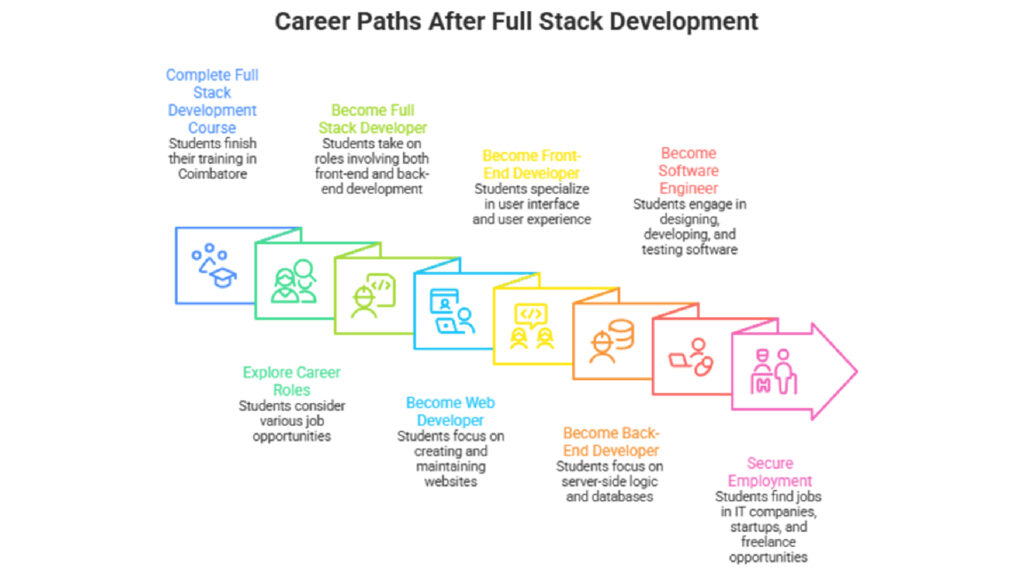
Career Opportunities After Learning Full Stack Development

Students who complete a Full Stack Development Courses in Coimbatore can explore several career roles, including:

  • Full Stack Developer
  • Web Developer
  • Front-End Developer
  • Back-End Developer
  • Software Engineer

These roles are available in IT companies, startups, product-based companies, and even freelance opportunities.


Full Stack Development Course

Learn Full Stack Development at V Net Academy, Coimbatore

If you are interested in building a career in the IT industry, enrolling in a Full Stack Development Courses in Coimbatore is a smart choice.

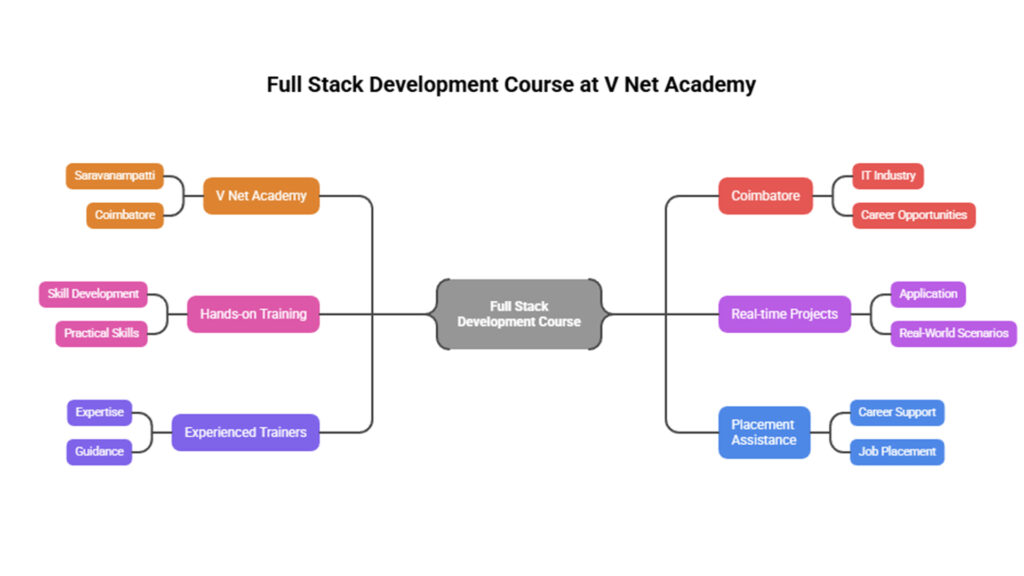
V Net Academy, Saravanampatti, Coimbatore provides industry-focused training designed to help students gain practical skills. The course includes:

  • Hands-on training
  • Real-time projects
  • Experienced trainers
  • Placement assistance

This training program helps students develop the skills required to become successful full stack developers.


Conclusion

Full Stack Development has become one of the most valuable skills in the technology industry. Companies are constantly looking for developers who can handle both front-end and back-end development.

With the growing demand for web applications and digital services, many students are choosing a Full Stack Development Courses in Coimbatore to build a successful IT career.

If you want to start your journey in web development, V Net Academy in Saravanampatti, Coimbatore can help you gain the skills, knowledge, and confidence needed to succeed in the software industry.

Why is Full Stack Development in high demand ?

Companies prefer hiring developers who can manage multiple aspects of a project, reducing costs, improving development speed, and maintaining better communication between teams. This versatility makes full stack developers highly sought after in the IT industry.

What skills do I need to become a Full Stack Developer ?

Key skills include:
Front-end: HTML, CSS, JavaScript, frameworks like React or Angular
Back-end: Node.js, Python, Java, PHP, databases (MySQL, MongoDB)
Other: Version control (Git), deployment tools, problem-solving, and debugging

What career opportunities are available after learning Full Stack Development ?

Graduates can pursue roles such as:
Full Stack Developer
Front-End Developer
Back-End Developer
Web Developer
Software Engineer
These roles are available in IT companies, startups, product-based companies, and even freelance opportunities.

READ MORE
Digital MarkettingVNetAdminFebruary 26, 2026
Share article:TwitterFacebookPinterestLinkedin
31 Views
0 Likes

Increase Online Sales Fast: Proven Digital Marketing Tips That Deliver Instant Results

Table of Contents

  • Introduction: Why Businesses Must Increase Online Sales Fast
  • Identify Quick-Win Opportunities in Your Marketing System
  • Optimize Your Website for Instant Conversions
    • 1. Improve User Experience (UX)
    • 2. Use Conversion-Focused Copy
  • Leverage Social Media for Immediate Sales Growth
    • Use Short-Form Content
    • Showcase Social Proof
  • Use Email Marketing for Quick Revenue Boost
  • Run High-ROI Paid Advertising Campaigns
    • Micro-Targeted Campaigns
    • Retargeting Ads
  • Create High-Intent Landing Pages
  • Craft Irresistible Offers
  • Use Analytics to Scale What Works
  • Conclusion: Turn Quick Wins into Long-Term Growth
    • How can I increase online sales fast without increasing my budget?
    • Does social media help increase online sales fast?
    • What is the fastest way to increase online sales fast?

Introduction: Why Businesses Must Increase Online Sales Fast

In today’s hyper-competitive digital marketplace, brands don’t have the luxury of waiting months to see results. Consumers make decisions within seconds. If your website, ads, or content fail to capture attention immediately, they move to a competitor.

To increase online sales fast, businesses must adopt agile, data-driven digital marketing strategies. Quick-impact tactics not only generate immediate revenue but also strengthen your long-term growth foundation.

Let’s explore the most effective methods that can help you increase online sales fast without wasting time or budget.


Identify Quick-Win Opportunities in Your Marketing System

Before investing in new campaigns, analyze your existing digital ecosystem.If you’re not sure where to start, run a proper digital marketing audit first. Often, hidden revenue opportunities are already present.

Start by reviewing:

  • Slow-loading pages
  • Weak call-to-action buttons
  • Confusing checkout processes
  • Poor mobile responsiveness

Fixing these issues alone can significantly increase online sales fast.

Also, evaluate underperforming traffic sources. Sometimes a small messaging tweak in email campaigns, social media posts, or landing pages can unlock immediate conversions.


Optimize Your Website for Instant Conversions

Your website is your primary sales engine. If you want to increase online sales fast, your site must remove friction and guide visitors smoothly toward purchase.

1. Improve User Experience (UX)

  • Reduce checkout steps
  • Enable guest checkout
  • Improve mobile speed
  • Use clear navigation

Even small UX improvements can produce instant results.

2. Use Conversion-Focused Copy

Your messaging should focus on benefits, not features. Use:

  • Clear value propositions
  • Emotional triggers
  • Urgency words (Limited Time, Exclusive Offer)
  • Strong CTA buttons (Buy Now, Get Instant Access)

Persuasive copy directly impacts your ability to increase online sales fast.


Increase Online Sales Fast

Leverage Social Media for Immediate Sales Growth

Social media platforms are powerful tools to increase online sales fast when used strategically.

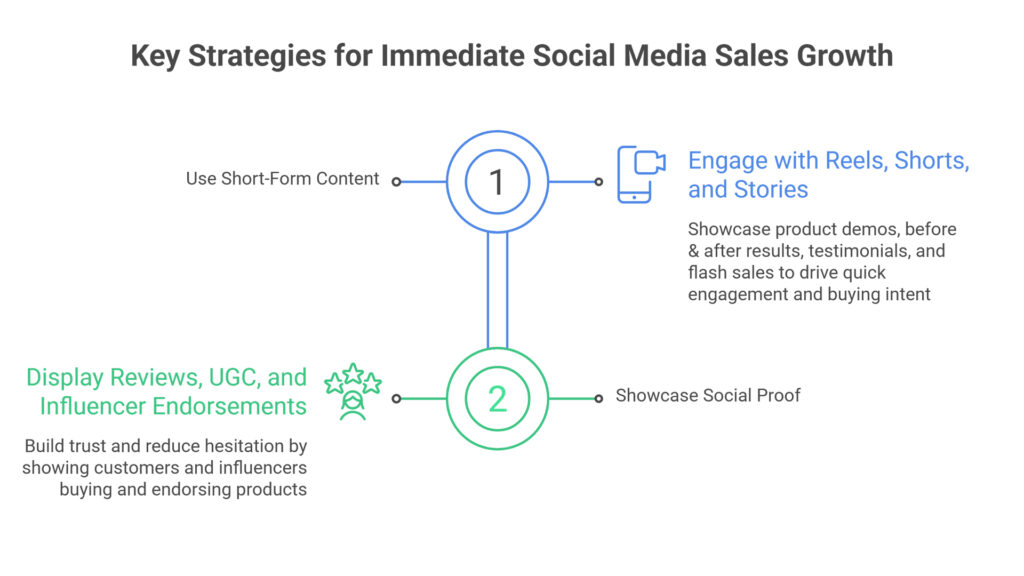
Use Short-Form Content

Reels, Shorts, and Stories drive quick engagement. Showcase:

  • Product demos
  • Before & after results
  • Customer testimonials
  • Flash sales

Short-form video increases trust and buying intent instantly.

Showcase Social Proof

Customers trust customers. Display:

  • Reviews
  • User-generated content
  • Influencer endorsements

When people see others buying, hesitation disappears.


Use Email Marketing for Quick Revenue Boost

Email marketing remains one of the highest ROI channels.

To increase online sales fast:

  • Send flash sale emails
  • Use limited-time discount offers
  • Add countdown timers
  • Personalize subject lines

Behavior-based emails like abandoned cart reminders can recover lost revenue within hours.


Increase Online Sales Fast

Run High-ROI Paid Advertising Campaigns

Paid ads are one of the fastest ways to increase online sales fast.

Micro-Targeted Campaigns

Target audiences based on:

  • Interests
  • Purchase behavior
  • Website visits

Warm audiences convert faster than cold traffic.

Retargeting Ads

People who visited your website but didn’t buy are highly valuable. Retarget them with:

  • Special discounts
  • Limited offers
  • Reminder ads

Retargeting campaigns often generate instant sales.


Create High-Intent Landing Pages

Dedicated landing pages convert better than general pages.

To increase online sales fast, your landing page must include:

  • Clear headline
  • One strong CTA
  • Testimonials
  • Money-back guarantee
  • Secure payment icons

Removing distractions increases conversion rates dramatically.


Craft Irresistible Offers

Sometimes the fastest way to increase online sales fast is simply improving your offer.

Try:

  • Product bundles
  • Buy 1 Get 1 offers
  • Limited-time bonuses
  • Free shipping

Scarcity and urgency trigger faster buying decisions.


Use Analytics to Scale What Works

Monitor real-time data:

  • Which ads are converting
  • Which landing pages perform best
  • Which email campaigns generate sales

Once you identify what’s working, scale it immediately. Quick optimization leads to fast revenue growth.


Conclusion: Turn Quick Wins into Long-Term Growth

To increase online sales fast, you need a combination of:

  • Optimized website experience
  • Strong offers
  • Smart advertising
  • Social proof
  • Continuous data tracking

Instant results are possible when strategy meets execution. The businesses that move fast, test consistently, and optimize intelligently are the ones that dominate the digital marketplace.

Start implementing these strategies today and watch your online revenue grow faster than ever.

How can I increase online sales fast without increasing my budget?

You can increase online sales fast by optimizing your existing website, improving user experience, strengthening your offer, and retargeting warm audiences instead of spending more on new traffic.

Does social media help increase online sales fast?

Yes. Short-form content, customer testimonials, and limited-time offers on platforms like Instagram and Facebook can quickly boost engagement and sales.

What is the fastest way to increase online sales fast?

The fastest way to increase online sales fast is by running retargeting ads, sending flash sale emails, and improving checkout conversion rates. Warm audiences usually convert immediately.

READ MORE
Hardware and NetworkVNetAdminFebruary 14, 2026
Share article:TwitterFacebookPinterestLinkedin
60 Views
2 Likes

Powerful Hardware and Networking Skills That Drive Modern IT Systems

Table of Contents

  • Introduction to Hardware and Networking Skills in Modern IT
  • How Hardware and Networking Skills Shape Today’s Technology Landscape
  • Why Modern Systems Depend on Strong Hardware and Networking Skills
  • Understanding Internal Hardware Components and System Architecture
  • CPU, Memory, Storage, and Motherboard Expertise
  • Hardware Installation, Configuration, and Optimization Skills
  • Diagnosing and Resolving Hardware Performance Issues
  • Fundamentals of Computer Networking
  • How Data Flows Across Connected Systems
  • Network Design and Implementation Skills
  • Understanding Network Topologies and Architectures
  • Routers, Switches, and Firewalls in Real-World Environments
  • Wireless Networking Skills for Modern Workplaces
  • Cabling and Physical Network Infrastructure Skills
  • Mastering Networking Protocols That Power the Internet
  • IP Addressing and Subnetting Proficiency
  • Network Standards and Interoperability Knowledge
  • How Operating Systems Interact with Hardware and Networks
  • Managing Windows, Linux, and macOS Environments
  • Hardware Troubleshooting Techniques Every Professional Should Know
  • Network Troubleshooting Skills for Complex Environments
  • Using Diagnostic Tools Effectively
  • Physical Security and Hardware Protection Practices
  • Network Security Skills for Modern Threats
  • Recognizing and Mitigating Common Security Risks
  • Preventive Hardware Maintenance Strategies
  • Network Monitoring and Performance Optimization
  • Documentation and Asset Management Best Practices
  • Emerging Hardware Technologies Shaping Modern Systems
  • Modern Networking Trends Transforming Infrastructure
  • Skills IT Professionals Need to Stay Relevant
  • What are hardware and networking skills?
  • What are the basic networking skills required for beginners?
  • Which operating systems are important for hardware and networking careers?

Introduction to Hardware and Networking Skills in Modern IT

Hardware and Networking Skills form the backbone of modern information technology and are built on strong hardware and networking basics. Every digital service depends on physical systems and interconnected networks that sustain performance, availability, and scalability. While software drives functionality, hardware and networking skills determine whether systems can withstand real-world demands.

Today’s IT infrastructure is dynamic and distributed. Mastery of hardware and networking skills enables professionals to manage this complexity with clarity, whether entering the field through a hardware and networking course or advancing toward specialized infrastructure roles.


How Hardware and Networking Skills Shape Today’s Technology Landscape

Speed, connectivity, and resilience define the modern technology landscape. Data travels globally in seconds, systems scale on demand, and failures must be anticipated rather than merely fixed. Hardware and networking skills shape this environment by ensuring that core infrastructure supports these expectations.

Professionals with strong hardware and networking skills guide architectural decisions, optimize system performance, and reduce infrastructure risk. Their expertise transforms raw technology into reliable platforms organizations depend on daily.


Why Modern Systems Depend on Strong Hardware and Networking Skills

Modern systems integrate on-premise resources, cloud platforms, and edge devices. Each layer introduces dependencies and operational risks. Strong hardware & networking skills help professionals anticipate system interactions, reduce latency, and maintain business continuity.

Without this foundation, hardware and networking troubleshooting becomes reactive, increasing downtime, costs, and reliability issues.


Core Hardware Skills Every IT Professional Must Master

Understanding Internal Hardware Components and System Architecture

System architecture defines how internal components interact and how data flows through a system. Deep hardware & networking skills support informed decisions related to upgrades, virtualization, and workload distribution.

CPU, Memory, Storage, and Motherboard Expertise

The CPU controls processing power, memory affects responsiveness, storage impacts data access, and the motherboard coordinates communication. Strong fundamentals in computer hardware and networking help professionals balance performance, stability, and cost efficiency when designing modern systems.

Hardware Installation, Configuration, and Optimization Skills

Strong hardware and networking skills go beyond installation. Proper configuration, airflow planning, power management, and performance tuning transform standard systems into reliable infrastructure.

Diagnosing and Resolving Hardware Performance Issues

Hardware failures often appear gradually. Methodical troubleshooting, component isolation, and monitoring are essential hardware & networking skills that prevent guesswork.


Hardware and Networking Skills

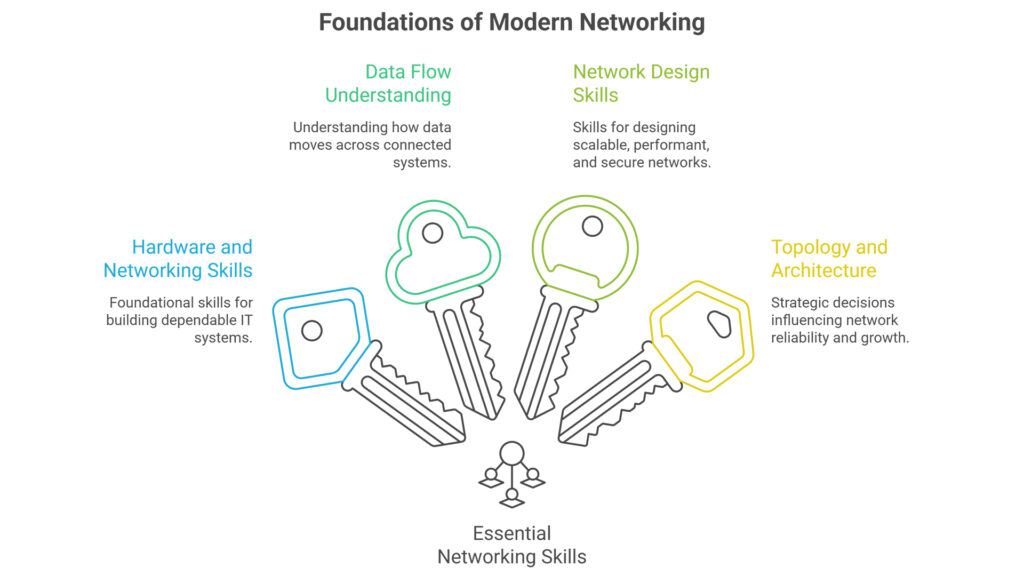
Essential Networking Skills for Modern Systems

Fundamentals of Computer Networking

Networking connects systems into unified environments for communication and resource sharing. For beginners, foundational hardware and networking skills are critical for building dependable IT systems.

How Data Flows Across Connected Systems

Data moves as packets governed by protocols and addressing rules. Understanding routing and switching behavior is a core part of advanced hardware & networking skills.

Network Design and Implementation Skills

Effective network design balances scalability, performance, and security. Well-planned implementation reflects strong hardware & networking skills and prevents costly redesigns.

Understanding Network Topologies and Architectures

Topology and architecture choices influence reliability and growth. Strategic decisions here rely heavily on professional hardware and networking skills.


Networking Devices and Infrastructure Expertise

Routers, Switches, and Firewalls in Real-World Environments

Routers manage inter-network traffic, switches handle internal communication, and firewalls enforce security policies. Correct configuration is a practical application of hardware & networking skills.

Wireless Networking Skills for Modern Workplaces

Wi-Fi design requires knowledge of standards, interference, and coverage planning—key components of modern hardware & networking skills.

Cabling and Physical Network Infrastructure Skills

Ethernet and fiber optics remain essential for speed and reliability. Proper cabling practices reflect strong foundational hardware & networking skills.


Hardware and Networking Skills

Protocols, Addressing, and Communication Skills

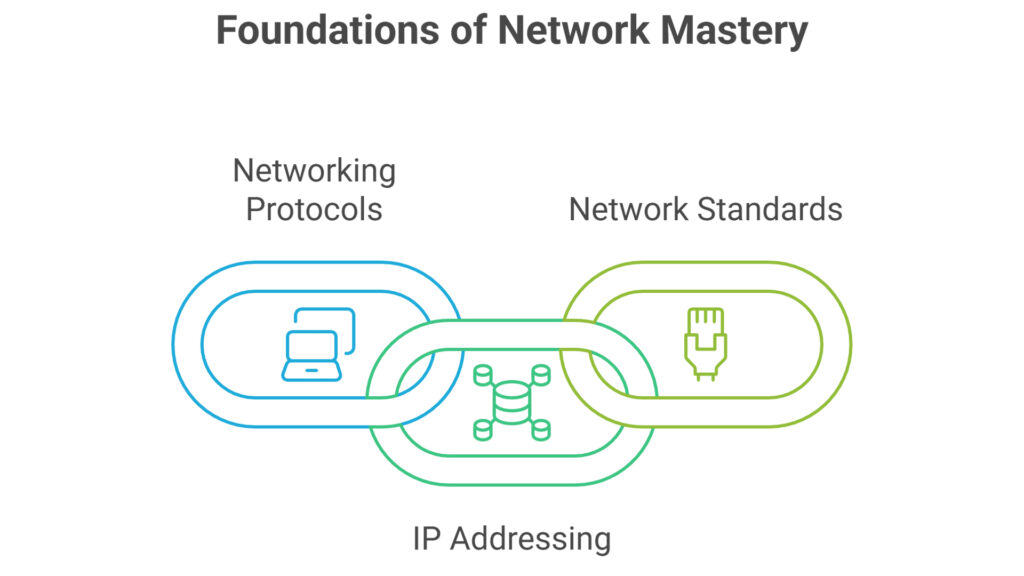
Mastering Networking Protocols That Power the Internet

Protocols such as TCP/IP, HTTP, and DNS define how systems communicate across the internet. These standards ensure reliable and secure data transmission, as outlined in global networking documentation by Cloudflare.

IP Addressing and Subnetting Proficiency

Efficient IP addressing and subnetting improve performance, security, and manageability—core outcomes of advanced hardware and networking skills.

Network Standards and Interoperability Knowledge

Standards ensure compatibility across vendors and platforms, protecting long-term infrastructure investments through strong hardware and networking skills.


Operating Systems and Infrastructure Management Skills

How Operating Systems Interact with Hardware and Networks

Operating systems manage hardware resources and network communication. Understanding this interaction is essential to professional hardware and networking skills.

Managing Windows, Linux, and macOS Environments

Cross-platform administration enhances flexibility. Managing Windows, Linux servers, and macOS environments is a valuable extension of hardware and networking skills in modern IT infrastructure.


Troubleshooting and Problem-Solving Skills

Hardware Troubleshooting Techniques Every Professional Should Know

Structured troubleshooting minimizes downtime by focusing on observation, testing, and isolation. Advanced network troubleshooting skills reduce downtime in enterprise environments and complex IT infrastructures.

Network Troubleshooting Skills for Complex Environments

Latency, packet loss, and connectivity issues demand layered analysis supported by strong hardware and networking skills.

Using Diagnostic Tools Effectively

Tools like ping, traceroute, logs, and monitoring platforms convert raw data into actionable insights through applied hardware and networking skills.


Security Skills for Hardware and Networking Systems

Physical Security and Hardware Protection Practices

Securing physical environments is a foundational layer of hardware and networking skills.

Network Security Skills for Modern Threats

Firewalls, encryption, and access controls are recommended by global cybersecurity standards to reduce modern attack surfaces, as outlined by NIST.

Recognizing and Mitigating Common Security Risks

Understanding vulnerabilities enables proactive defense and faster incident response through advanced hardware and networking skills.


Maintenance, Monitoring, and Optimization Skills

Preventive Hardware Maintenance Strategies

Routine maintenance extends hardware lifespan and prevents unexpected failures—an essential part of hardware and networking skills.

Network Monitoring and Performance Optimization

Continuous monitoring ensures uptime and efficient traffic flow using professional hardware and networking skills.

Documentation and Asset Management Best Practices

Clear documentation simplifies audits, troubleshooting, and infrastructure planning, reinforcing strong hardware and networking skills.


Future-Ready Hardware and Networking Skills

Emerging Hardware Technologies Shaping Modern Systems

Edge computing, IoT, and specialized processors are redefining infrastructure boundaries, expanding the scope of hardware and networking skills.

Modern Networking Trends Transforming Infrastructure

Cloud networking, virtualization, and software-defined networking are making networks more flexible and programmable—key areas for evolving hardware and networking skills.

Skills IT Professionals Need to Stay Relevant

Continuous learning, hands-on experience, and hardware and networking certification support long-term career growth in hardware and networking jobs. Training providers like VNET Academy help develop industry-ready professionals. Despite rapid technological change, strong hardware and networking skills remain essential.

What are hardware and networking skills?

Hardware & networking skills refer to the ability to install, configure, manage, and troubleshoot computer hardware components and network systems used in modern IT infrastructure.

What are the basic networking skills required for beginners?

Beginners should learn computer networking fundamentals, IP addressing, subnetting, network devices, cabling, and basic network troubleshooting techniques.

Which operating systems are important for hardware and networking careers?

Windows, Linux, and macOS are important. Linux, in particular, is widely used for servers, networking tools, and infrastructure management.

READ MORE
Hardware and NetworkVNetAdminFebruary 9, 2026
Share article:TwitterFacebookPinterestLinkedin
83 Views
2 Likes

Hardware and Networking Troubleshooting Explained for Faster Issue Resolution – Ultimate Guide

Table of Contents

  • Introduction to Hardware and Networking Troubleshooting
  • Why Hardware and Networking Troubleshooting Speeds Up Problem Resolution
  • The Impact of Slow Hardware and Networking Troubleshooting
  • Foundations of Effective Hardware & Networking Troubleshooting
    • The Troubleshooting Mindset
    • Common Mistakes That Delay Troubleshooting
  • Essential Hardware Knowledge for Troubleshooting
    • Core Hardware Components and Failure Patterns
    • Peripheral Hardware Issues
    • Hardware Symptoms and Root Causes
  • Networking Fundamentals for Hardware and Networking Troubleshooting
    • How Data Moves Across Networks
    • Network Types and Common Issues
    • Network Topology and Troubleshooting Impact
  • Networking Devices and Failure Scenarios
    • Security Devices in Troubleshooting
    • Physical Cabling and Infrastructure Issues
  • Protocol and Configuration Errors
  • Operating Systems and System Diagnostics
  • Practical Tools for Hardware and Networking Troubleshooting
  • Building a Repeatable Hardware and Networking Troubleshooting Workflow
  • Preventive Practices to Reduce Troubleshooting Incidents
  • Conclusion: Mastering Hardware and Networking Troubleshooting
    • What is hardware and networking troubleshooting?
    • Which tools are used for hardware & networking troubleshooting?
    • Why is hardware and networking troubleshooting important in IT?

Introduction to Hardware and Networking Troubleshooting

Hardware and Networking Troubleshooting is a disciplined and structured practice built on strong fundamentals rather than guesswork. Hardware and networking form the backbone of every IT environment, and when systems fail, problems usually appear first at these layers. Professionals who master hardware and networking troubleshooting often begin by strengthening their fundamentals through a hardware and networking course.

In complex infrastructures, issues rarely reveal their root cause directly. A network failure may look like an application problem, while failing storage hardware can mimic software crashes. Strong hardware and networking troubleshooting knowledge removes this confusion and accelerates resolution.


Why Hardware and Networking Troubleshooting Speeds Up Problem Resolution

A clear understanding of hardware and networking troubleshooting transforms issue resolution into a logical elimination process. Symptoms are mapped to probable causes, assumptions are verified quickly, and root problems are identified earlier. This approach strengthens real-world hardware and networking skills.

Faster troubleshooting reduces downtime and operational stress. In professional IT environments, efficient hardware & networking troubleshooting directly improves system reliability and professional credibility.


The Impact of Slow Hardware and Networking Troubleshooting

Delayed hardware and networking troubleshooting leads to increased downtime, loss of productivity, and damaged user trust. In modern IT infrastructures, a single unresolved hardware or network issue can trigger cascading failures. Formal training through a hardware and networking course helps professionals resolve incidents quickly before they escalate.


Foundations of Effective Hardware & Networking Troubleshooting

The Troubleshooting Mindset

Effective hardware & networking troubleshooting starts with discipline. Observation comes before action. Problems are isolated, hypotheses are tested one at a time, and solutions are validated properly. This prevents temporary fixes that hide symptoms without resolving root causes.

Common Mistakes That Delay Troubleshooting

Frequent errors include skipping basic hardware checks, rebooting systems without analysis, ignoring system logs, and making multiple changes simultaneously. Another major issue is tunnel vision. Successful hardware and networking troubleshooting requires examining hardware, network, and operating system layers together.


Hardware and Networking Troubleshooting

Essential Hardware Knowledge for Troubleshooting

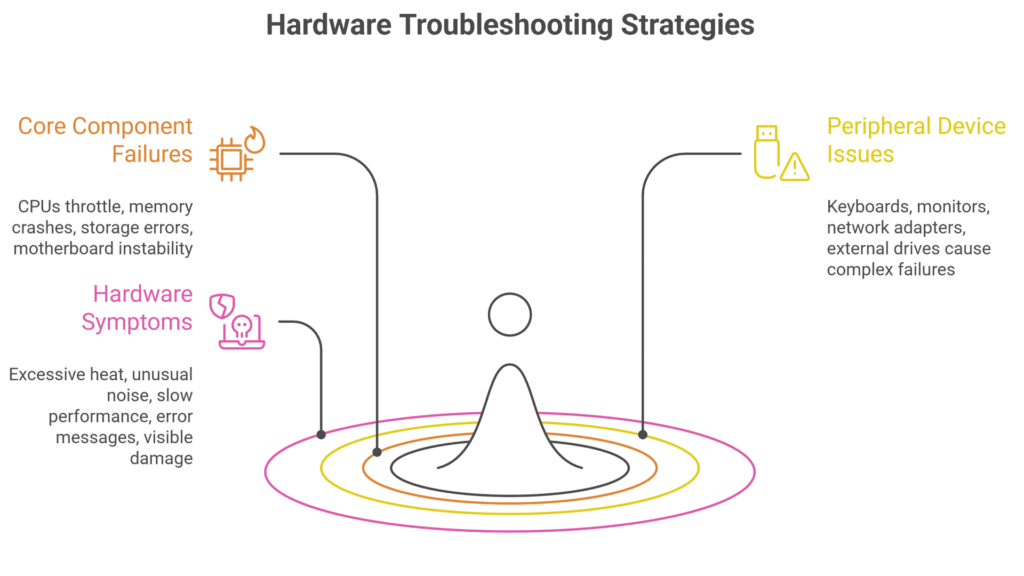
Core Hardware Components and Failure Patterns

Internal components fail in predictable ways. CPUs throttle during overheating, memory failures cause intermittent crashes, storage devices show read/write errors, and motherboards experience power instability. Recognizing these patterns improves hardware troubleshooting speed.

Peripheral Hardware Issues

Peripheral devices such as keyboards, monitors, network adapters, and external drives can cause failures that appear complex. In hardware & networking troubleshooting, isolation and replacement testing are often the fastest solutions.

Hardware Symptoms and Root Causes

Common hardware symptoms include excessive heat, unusual noise, slow performance, error messages, and visible damage. These signals narrow down troubleshooting efforts quickly.


Networking Fundamentals for Hardware and Networking Troubleshooting

How Data Moves Across Networks

Data travels in packets that are addressed, routed, transmitted, and acknowledged. Latency, bandwidth, and packet loss directly affect performance. Understanding packet flow aligns closely with the OSI model explained in detail by Cisco networking documentation.

Network Types and Common Issues

LAN networks face cabling and switch configuration problems. WAN networks introduce latency and ISP dependency. Wireless networks suffer from interference and coverage limitations. Hybrid networks combine all these challenges, making hardware & networking troubleshooting critical.

Network Topology and Troubleshooting Impact

Network topology influences fault isolation. Star topologies simplify troubleshooting, while flat or mesh networks increase complexity. Proper segmentation improves network troubleshooting efficiency.


Hardware and Networking Troubleshooting

Networking Devices and Failure Scenarios

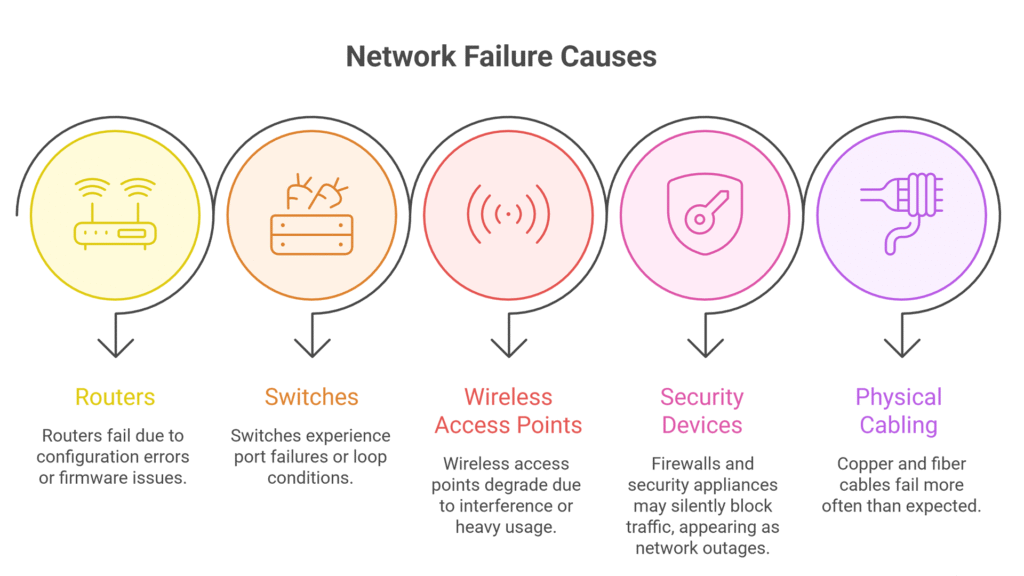
Routers fail due to configuration errors or firmware issues. Switches experience port failures or loop conditions. Wireless access points degrade due to interference or heavy usage. Distinguishing between configuration issues and hardware failures is essential in hardware & networking troubleshooting.

Security Devices in Troubleshooting

Firewalls and security appliances may silently block traffic, appearing as network outages. Hardware & networking troubleshooting must include security log analysis to confirm policy-based issues.

Physical Cabling and Infrastructure Issues

Copper and fiber cables fail more often than expected. Damaged connectors, improper termination, and bent fiber cause intermittent connectivity problems. Physical inspection remains a key step in hardware and networking troubleshooting.


Protocol and Configuration Errors

Protocols behave predictably during failure. TCP retransmissions, DNS timeouts, DHCP failures, and routing issues provide valuable clues. Avoiding configuration mistakes such as duplicate IP addresses, incorrect gateways, and overlapping subnets improves network stability.


Operating Systems and System Diagnostics

Operating systems provide valuable insights through logs and alerts. Ignoring these signals slows hardware and networking troubleshooting. Driver conflicts, firmware mismatches, and compatibility issues commonly appear after updates.


Practical Tools for Hardware and Networking Troubleshooting

Tools such as ping, traceroute, ipconfig, and netstat help diagnose connectivity and configuration issues. Hardware diagnostic utilities detect memory faults, disk errors, and thermal issues, extending visibility beyond surface symptoms.


Building a Repeatable Hardware and Networking Troubleshooting Workflow

Structured approaches such as bottom-up troubleshooting or OSI layer models ensure consistency. Documentation converts individual experience into organizational knowledge and supports long-term growth, often strengthened through a hardware and networking certification.


Preventive Practices to Reduce Troubleshooting Incidents

Proactive maintenance, monitoring, timely updates, and lifecycle planning reduce unexpected failures. Network baselining helps detect anomalies early and simplifies future hardware & networking troubleshooting.


Conclusion: Mastering Hardware and Networking Troubleshooting

Strong fundamentals in hardware & networking troubleshooting turn system symptoms into clear diagnostic signals. Troubleshooting becomes faster, more accurate, and reliable. As skills improve, confidence and career opportunities grow. Continuous learning through platforms such as Vnet Academy ensures hardware and networking troubleshooting expertise remains relevant in evolving IT environments.Strong troubleshooting skills also improve eligibility for entry-level hardware and networking jobs in IT support and network operations.

What is hardware and networking troubleshooting?

Hardware & networking troubleshooting is the process of identifying, analyzing, and fixing issues related to computer hardware components and network connectivity using structured diagnostic methods.

Which tools are used for hardware & networking troubleshooting?

Tools such as ping, traceroute, ipconfig, netstat, system logs, and hardware diagnostic utilities are widely used for effective hardware and networking troubleshooting.

Why is hardware and networking troubleshooting important in IT?

Hardware & networking troubleshooting helps reduce system downtime, improve performance, and prevent recurring failures. Strong troubleshooting skills allow IT professionals to resolve issues faster and maintain reliable systems.

READ MORE
Machine LearningVNetAdminFebruary 5, 2026
Share article:TwitterFacebookPinterestLinkedin
115 Views
3 Likes

Machine Learning Secrets Behind Smart Apps and AI

Machine Learning Secrets Behind Smart Apps explain how modern applications use data, algorithms, and intelligent models to deliver personalized and predictive user experiences.

Table of Contents

  • Introduction: The Hidden Intelligence Powering Smart Apps and AI
  • What Makes Smart Apps Intelligent Using Machine Learning Secrets
  • Core Machine Learning Foundations Behind Smart Apps
  • Learning From Users: The Secret Feedback Loop
  • Algorithms That Power Intelligent Experiences
  • Models That Remember and Improve Over Time
  • Personalization Engines Inside Smart Applications
  • Behind the Scenes of AI-Powered Features
  • From Data to Decisions: The Smart App Pipeline
  • Edge AI and On-Device Intelligence
  • Ethical Design in Smart Apps and AI
  • Scaling Machine Learning for Millions of Users
  • Future Innovations in Smart Apps and AI
  • Conclusion: Unlocking the Secrets Behind Intelligent Technology
    • What are Machine Learning Secrets Behind Smart Apps?
    • What types of machine learning are used in smart applications?
    • Why is ethical machine learning important for smart apps?

Introduction: The Hidden Intelligence Powering Smart Apps and AI

Machine Learning Secrets Behind Smart Apps reveal how modern applications quietly learn, adapt, and respond with uncanny precision. Smart applications rarely announce their intelligence. They simply work. They anticipate needs, adapt to preferences, and respond with accuracy.

This apparent effortlessness is the result of Machine Learning basics operating silently beneath the interface, transforming ordinary software into responsive, predictive systems. This section serves as a clear Machine Learning introduction and Machine Learning overview for modern digital products.

Modern apps feel intuitive because they learn continuously. Every interaction refines behavior. Every signal improves relevance. Understanding what is Machine Learning explains why it has become the invisible infrastructure powering everyday digital experiences, from navigation and entertainment to productivity and communication.


What Makes Smart Apps Intelligent Using Machine Learning Secrets

Intelligence in software is not defined by flashy features or complex interfaces. It is defined by adaptability, which lies at the core of essential Machine Learning concepts. A truly smart system can observe, learn, and evolve based on new information.

Traditional applications rely on static rules. Smart systems replace rigidity with learning through proven Machine Learning methods and Machine Learning techniques. Data-driven decision-making allows applications to adjust behavior dynamically, optimizing outcomes as conditions change.


Core Machine Learning Foundations Behind Smart Apps

Data is the raw material of intelligence. Without data, even the most advanced Machine Learning algorithms remain inactive. In smart applications, data captures behavior, context, and outcomes, forming the foundation for Supervised Machine Learning, Unsupervised Machine Learning, and Reinforcement Machine Learning.

Features represent measurable signals. Labels define desired results. Learning signals guide Machine Learning optimization and improve Machine Learning accuracy. Clean, relevant data consistently produces stronger Machine Learning models than large but unreliable datasets.


Learning From Users: The Secret Feedback Loop

User behavior is a constant stream of instruction. Every click, swipe, pause, and search communicates intent and fuels real-world Machine Learning applications.

This feedback loop is continuous. Systems refine predictions using practical Machine Learning use cases that convert interaction data into smarter digital experiences, improving relevance across platforms.


Machine Learning Secrets Behind Smart Apps

Algorithms That Power Intelligent Experiences

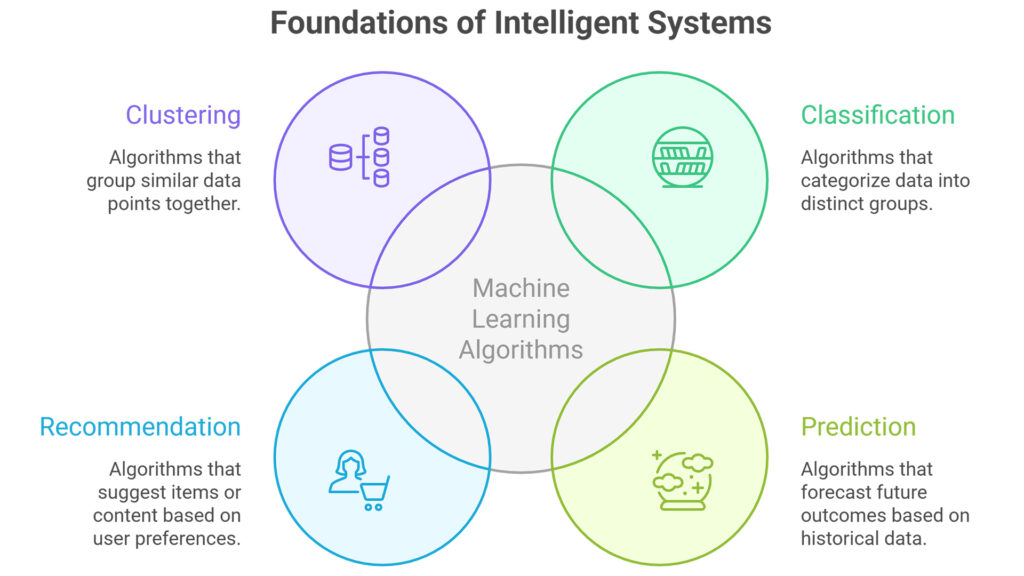
Algorithms are the decision engines behind smart applications. Classification, prediction, and recommendation systems are foundational Machine Learning algorithms used across industries.

Clustering enables personalization at scale, while predictive models influence outcomes in Machine Learning in business, Machine Learning in finance, and consumer platforms. Choosing the right algorithm directly impacts performance, fairness, and reliability.


Machine Learning Secrets

Models That Remember and Improve Over Time

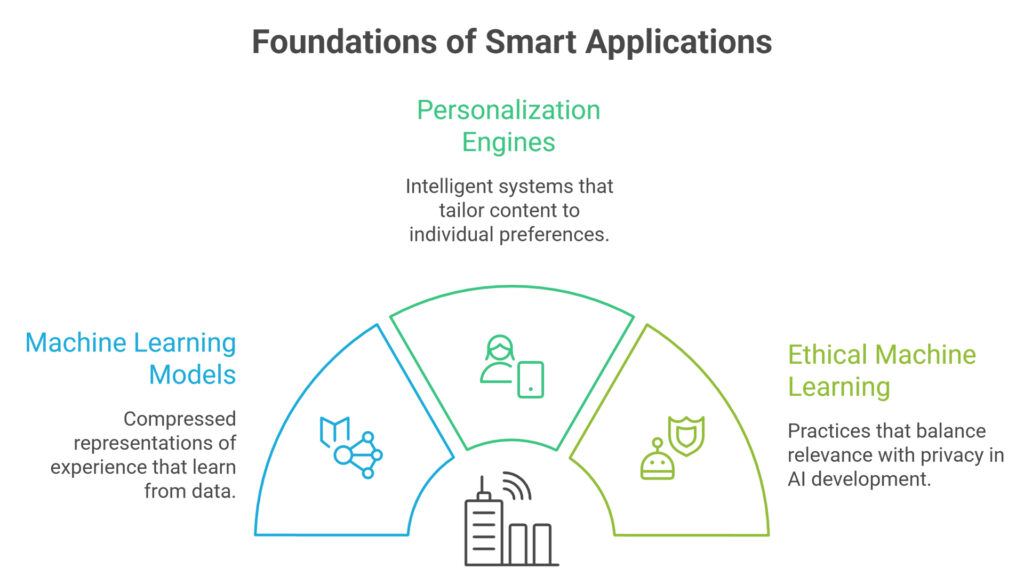
A Machine Learning model is a compressed representation of experience. It stores patterns learned from historical data, enabling accurate inference on new inputs.

Training builds intelligence. Inference delivers value. Continuous updates ensure models remain relevant, accurate, and aligned with changing user behavior.


Personalization Engines Inside Smart Applications

Personalization is one of the most visible results of Machine Learning Secrets Behind Smart Apps. Intelligent systems tailor content using advanced Machine Learning techniques that adapt to individual preferences.

Smart design balances relevance with privacy, applying ethical Machine Learning practices to deliver contextual awareness without overreach.Personalization Engines Inside Smart Applications Using Machine Learning Secrets Behind Smart Apps


Behind the Scenes of AI-Powered Features

Speech recognition, natural language understanding, and image recognition rely on Deep Learning vs Machine Learning architectures working together.

Conversational AI, chatbots, and virtual assistants demonstrate applied intelligence powered by scalable models trained using modern Machine Learning frameworks and Machine Learning libraries.


From Data to Decisions: The Smart App Pipeline

Data flows through structured pipelines supported by robust Machine Learning software and cloud platforms. Preprocessing, feature engineering, training, and deployment are critical stages.

Real-time inference and batch processing are optimized using Python for Machine Learning and industry-standard Machine Learning tools.


Edge AI and On-Device Intelligence

Edge AI brings intelligence closer to users. On-device learning reduces latency, improves privacy, and extends Machine Learning applications to offline environments.

This shift enhances trust and performance without sacrificing capability.


Ethical Design in Smart Apps and AI

Responsible intelligence is essential. Ethical systems reduce bias and prioritize transparency through explainable Machine Learning models.

Trust grows when users understand how decisions are made and why outcomes occur.


Scaling Machine Learning for Millions of Users

Growth demands resilient systems. Continuous monitoring ensures sustained Machine Learning accuracy, while drift detection maintains relevance at scale.

Operational excellence is just as important as algorithmic strength.


Future Innovations in Smart Apps and AI

Multimodal intelligence will shape the next era of technology. Autonomous systems will combine text, vision, and context to deliver richer and more human-like experiences.

As platforms evolve, Machine Learning applications will become more proactive, adaptive, and collaborative.


Conclusion: Unlocking the Secrets Behind Intelligent Technology

Machine Learning Secrets Behind Smart Apps form the silent engine behind modern smart apps and AI. They power everything from personalization to prediction.

For learners seeking a Machine Learning tutorial, Machine Learning course, or Machine Learning training, platforms that help Learn Machine Learning online provide strong foundations. Machine Learning for beginners opens pathways to Machine Learning jobs, a clear Machine Learning career path, and roles such as Machine Learning Engineer. With the right Machine Learning skills, competitive Machine Learning salary opportunities emerge across industries. Institutions like VNET Academy support this journey from fundamentals to professional mastery.

What are Machine Learning Secrets Behind Smart Apps?

Machine Learning Secrets Behind Smart Apps refer to the hidden algorithms, data models, and learning techniques that enable applications to understand user behavior, adapt in real time, and deliver intelligent, personalized experiences without manual programming.

What types of machine learning are used in smart applications?

Most smart applications rely on Supervised Machine Learning, Unsupervised Machine Learning, and Reinforcement Learning. These methods help apps classify data, discover patterns, and continuously improve decisions based on feedback.

Why is ethical machine learning important for smart apps?

Ethical machine learning ensures fairness, transparency, and privacy. Smart apps must minimize bias and explain decisions clearly so users can trust AI-powered systems.

READ MORE
Machine LearningVNetAdminFebruary 5, 2026
Share article:TwitterFacebookPinterestLinkedin
183 Views
6 Likes

Powerful Machine Learning Trends That Are Shaping the Future

Table of Contents

  • Introduction to the New Era of Machine Learning
  • Why Machine Learning Is Accelerating So Rapidly
  • Key Forces Driving Modern Machine Learning Trends
    • Growth of Data and Computing Power
    • Advances in Algorithms and Model Design
    • Rising Demand for Intelligent Automation
  • Generative AI and Foundation Models
    • Large Language and Multimodal Models
    • Impact of Generative AI on Creativity and Business
  • Automation and AutoML Evolution
    • Making Machine Learning Accessible
    • Faster Deployment and Experimentation
  • Edge AI and On-Device Machine Learning
    • Real-Time Intelligence and Privacy
  • Responsible and Ethical Machine Learning
    • Explainable and Fair AI
    • Governance and Compliance
  • Machine Learning Across Industries
  • MLOps and Scalable Deployment
  • Human-in-the-Loop Machine Learning
  • Future Skills and Career Opportunities
  • Conclusion: The Future Shaped by Machine Learning Trends
    • What are Machine Learning Trends?
    • Why are Machine Learning Trends important for the future?
    • What is the best way to start learning Machine Learning?

Introduction to the New Era of Machine Learning

Machine Learning is entering a powerful new phase and has become a core part of modern digital systems. Today, Machine Learning Trends show how intelligent systems can learn faster, adapt to change, and scale across real-world environments. Those who want to build strong foundations can start with a Machine Learning course designed for beginners and professionals.

Why Machine Learning Is Accelerating So Rapidly

One clear Machine Learning Trend is the speed of innovation. Models that once took years to build can now be trained and deployed in a matter of weeks. This acceleration is driven by massive data availability, powerful hardware, and practical adoption across industries. Machine Learning is no longer theoretical—it has become a critical part of business operations and digital infrastructure.According to industry research, the rapid adoption of AI and Machine Learning is driven by data growth and computing advancements.

Key Forces Driving Modern Machine Learning Trends

Several connected forces are shaping how Machine Learning evolves today. Together, they are pushing organizations to adopt intelligent systems at scale.

Growth of Data and Computing Power

Data has become the fuel behind Machine Learning Trends. With access to large datasets and advanced computing resources like GPUs and TPUs, organizations can train more accurate and efficient Machine Learning models. These capabilities allow algorithms to perform complex tasks that were once impossible. These developments are explained in detail in our guide on Machine Learning basics for real-world applications.

Advances in Algorithms and Model Design

Another major Machine Learning Trend is the improvement of algorithms and model architectures. Techniques such as transformer models and self-supervised learning help systems understand patterns better and generalize across tasks. This progress has also sparked discussions around the practical differences between deep learning and traditional Machine Learning.

Rising Demand for Intelligent Automation

Businesses increasingly rely on automation to improve speed and accuracy. Machine Learning Trends in automation help reduce errors, optimize workflows, and support better decision-making. As a result, Machine Learning in business has become a strong competitive advantage.

Machine Learning Trends

Generative AI and Foundation Models

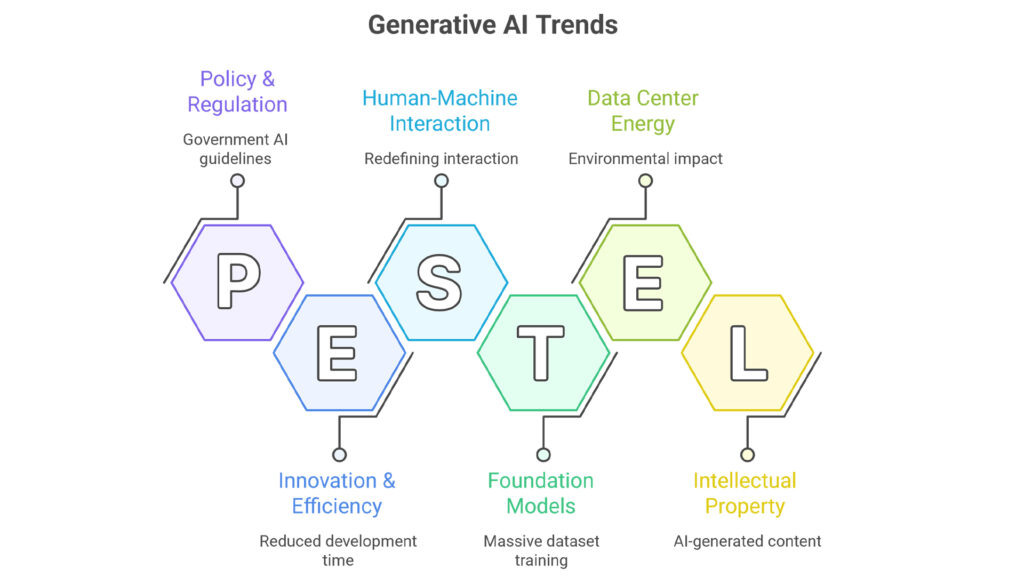
Generative AI is one of the most transformative Machine Learning Trends today. Foundation models trained on massive datasets can be adapted for multiple tasks, from text generation to image creation. This flexibility is changing how products are built and how innovation happensGenerative AI is one of the most transformative Machine Learning Trends today. Foundation models trained on massive datasets can be adapted for multiple tasks, from text generation to image creation. This flexibility is changing how products are built and how innovation happens. Generative AI adoption is growing rapidly across industries worldwide..

Large Language and Multimodal Models

Large language models and multimodal systems are redefining human-machine interaction. These Machine Learning Trends allow systems to understand and process text, images, audio, and video together, leading to more natural and accurate results.

Impact of Generative AI on Creativity and Business

Generative Machine Learning is helping teams create content faster and explore new ideas. In business, these trends reduce costs, speed up innovation, and open new revenue opportunities through personalization and automation.

Automation and AutoML Evolution

Automation has moved beyond simple tasks. AutoML is a growing Machine Learning Trend that enables systems to design, train, and optimize models automatically, making Machine Learning more accessible and scalable.Many professionals learn these skills through structured Machine Learning training programs that focus on automation and AutoML.

Making Machine Learning Accessible

With AutoML tools, even non-experts can build Machine Learning solutions. This democratization is an important trend, allowing analysts and managers to work with data-driven systems without deep coding knowledge.

Faster Deployment and Experimentation

Automated pipelines shorten development cycles, helping organizations test ideas quickly and improve Machine Learning applications continuously.

Edge AI and On-Device Machine Learning

Edge AI is another important Machine Learning Trend. Instead of relying only on cloud servers, intelligence is moving closer to where data is generated.

Real-Time Intelligence and Privacy

On-device Machine Learning enables real-time decision-making in areas like healthcare devices, smart sensors, and autonomous systems. It also improves privacy by processing data locally rather than sending it to the cloud.

Responsible and Ethical Machine Learning

As Machine Learning adoption grows, ethical responsibility has become essential. Modern Machine Learning Trends focus on fairness, transparency, and accountability.

Explainable and Fair AI

Explainable AI helps users understand how decisions are made, which is especially important in sectors like healthcare and finance. Bias detection and fairness-by-design approaches ensure more responsible outcomes.

Governance and Compliance

Regulations around the world are shaping how Machine Learning systems are developed and deployed, balancing innovation with trust.

Machine Learning Across Industries

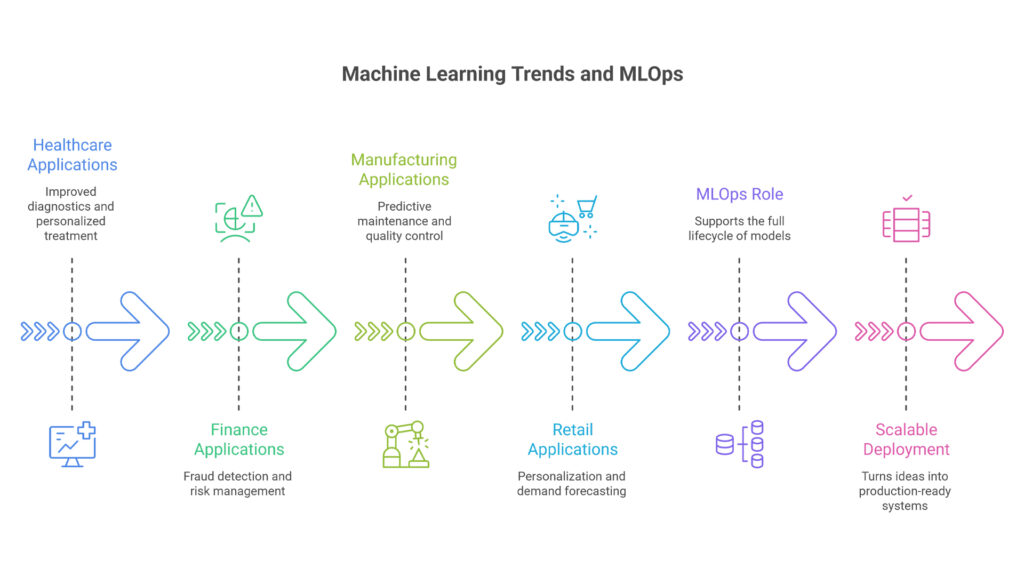
Machine Learning Trends are transforming industries through real-world use cases.

  • Healthcare: Improved diagnostics and personalized treatment
  • Finance: Fraud detection and risk management
  • Manufacturing: Predictive maintenance and quality control
  • Retail: Personalization and demand forecasting

MLOps and Scalable Deployment

MLOps plays a key role in turning Machine Learning ideas into production-ready systems. It supports the full lifecycle of models, from development to monitoring and optimization.

Human-in-the-Loop Machine Learning

Despite automation, human involvement remains critical. Human-in-the-loop approaches combine machine efficiency with human judgment, reducing risk and improving reliability in high-stakes decisions.

Future Skills and Career Opportunities

As Machine Learning Trends continue to evolve, the workforce must adapt to new tools and roles. New positions such as Machine Learning engineers and AI specialists are in high demand across industries. Continuous learning through a Machine Learning course, training program, or tutorial is essential for long-term success.

Conclusion: The Future Shaped by Machine Learning Trends

Machine Learning Trends represent lasting change, not a temporary phase. As edge intelligence, ethical AI, automation, and human collaboration come together, opportunities grow for both beginners and professionals. By learning Machine Learning online, building strong skills, and following a clear career path with competitive salary prospects, Individuals can thrive in the AI-driven future—supported by learning platforms like VNET Academy

What are Machine Learning Trends?

Machine Learning Trends refer to the latest developments and directions in how Machine Learning technologies are evolving. These include advancements in automation, Generative AI, Edge AI, ethical AI practices, and large-scale deployment across industries.

Why are Machine Learning Trends important for the future?

Machine Learning Trends shape how businesses operate, how decisions are made, and how technology integrates into everyday life. Staying updated helps professionals and organizations remain competitive in an AI-driven world.

What is the best way to start learning Machine Learning?

Beginners should start with Machine Learning basics, real-world examples, and guided learning paths. Online platforms and academies that offer structured courses help learners progress faster and more confidently.

READ MORE
Machine LearningVNetAdminFebruary 2, 2026
Share article:TwitterFacebookPinterestLinkedin
68 Views
5 Likes

Machine Learning Explained: How Machines Learn Like Humans

Introduction to Machine Learning and Human-Like Intelligence

Machine Learning Explained in simple terms refers to how computers learn from data and experience, similar to how humans learn over time. Machine Learning has become a driving force behind modern technology and forms the foundation of machine learning basics. It enables machines to perform tasks once limited to human intelligence, such as speech recognition, image analysis, and decision-making.
This introduction to machine learning offers a clear overview of how intelligent systems improve automatically using data.


What Does Machine Learning Really Mean?

What is machine learning in simple terms? Machine learning explained means teaching machines to recognize patterns from data instead of following fixed, hand-written rules. These machine learning concepts allow systems to adapt, scale, and improve performance using proven machine learning methods across multiple applications.


Why Machine Learning Is Compared to the Human Brain

The comparison exists because of functional similarity. Like humans, machine learning systems process inputs, store experience, and improve over time. Artificial neural networks and machine learning models are inspired by how the human brain learns, remembers, and recalls information, making machine learning explained relatable to human learning behavior.


How Humans Learn and Adapt Over Time

Humans learn through observation, repetition, and feedback. This gradual improvement process closely mirrors how machine learning algorithms refine predictions, improve accuracy, and adapt to new data through continuous learning.


How Machine Learning Learns Like Humans

In machine learning explained practically, machines learn through exposure to large volumes of data and feedback. Using machine learning techniques, systems reduce errors, optimize outcomes, and improve long-term performance through training and evaluation.


Patterns, Data, and Digital Memory

Data acts as digital memory for machines. High-quality datasets allow machine learning models to recognize patterns and make accurate predictions. Better data leads to smarter decisions, making data quality a key pillar in machine learning explained clearly.


Algorithms and Models as Learned Experience

Machine learning algorithms define how learning happens, while models store what has been learned. Together, they form the backbone of intelligent systems and are essential topics in any machine learning tutorial.


Machine Learning Explained: How Machines Learn Like Humans

Types of Machine Learning and Human Parallels

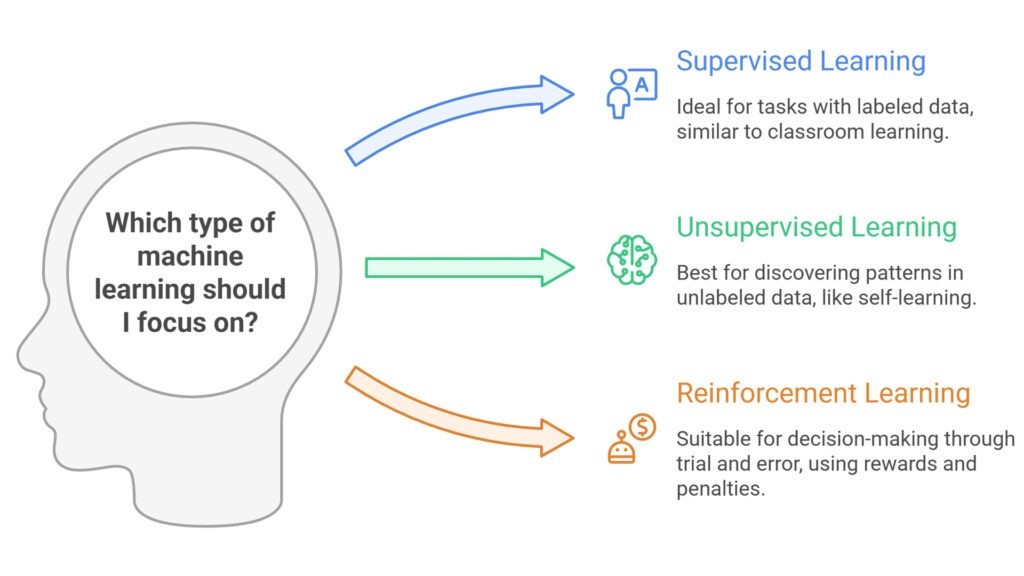
Understanding machine learning explained by types helps beginners grasp its core ideas:

  • Supervised Machine Learning – Similar to classroom learning with labeled examples
  • Unsupervised Machine Learning – Self-learning through pattern discovery
  • Reinforcement Learning – Trial-and-error learning using rewards and penalties

These are the most common machine learning techniques used across industries.


The Machine Learning Process: From Data to Decisions

The machine learning process begins with data collection and preparation using machine learning tools and software. Models are trained using Python for machine learning and popular frameworks, tested for accuracy, and continuously improved to stay relevant.


Real-World Examples of Human-Like Machine Learning

Machine learning explained through real-world examples shows its everyday impact:

  • Speech recognition in voice assistants
  • Image recognition in healthcare and security
  • Recommendation systems in shopping and entertainment

These use cases demonstrate how machine learning influences daily life.


Machine Learning Explained

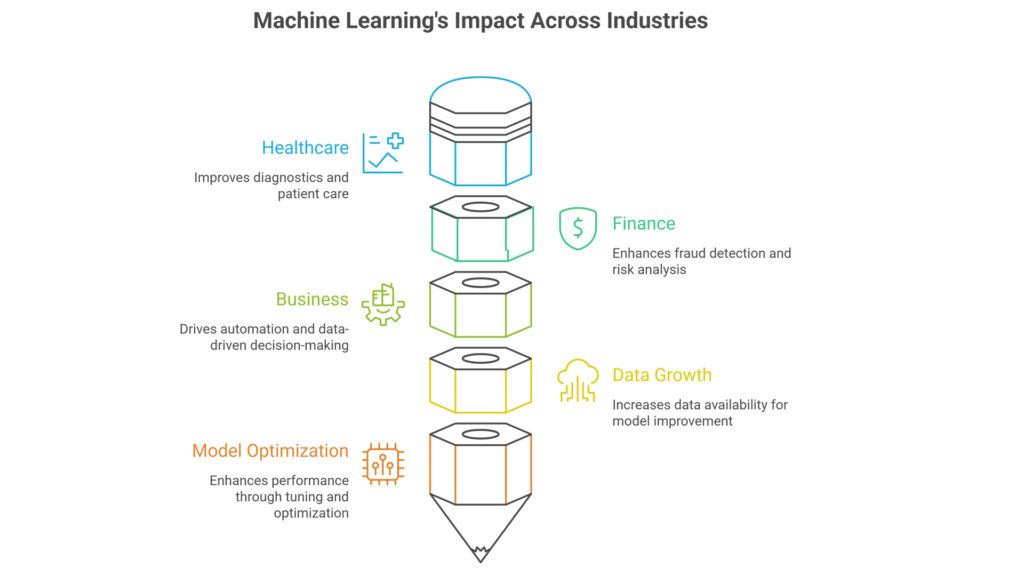
Machine Learning in Key Industries

  • Machine learning in healthcare improves diagnostics and patient care
  • Machine learning in finance enhances fraud detection and risk analysis
  • Machine learning in business drives automation and data-driven decision-making

How Machine Learning Improves With Experience

As more data becomes available, models improve automatically. Big data strengthens predictions, while tuning and optimization enhance performance across machine learning libraries and platforms.


Limitations and Common Myths

Despite its power, machine learning has limitations. Machines lack creativity, empathy, and true understanding. Deep learning vs machine learning comparisons highlight advanced capabilities without genuine human intelligence.


Ethical Considerations and Responsible Use

Bias in training data can lead to unfair outcomes. Transparency, accountability, and fairness are essential for responsible use of machine learning systems.


Future of Machine Learning and Human-Like AI

The future of machine learning explained shows massive growth across industries. Demand for machine learning jobs is increasing, with clear career paths for roles like machine learning engineer, offering strong salary potential for skilled professionals.


Conclusion: What Machine Learning Means for the Human Future

Machine Learning Explained shows how humans and machines can collaborate effectively. From machine learning for beginners to advanced professionals, opportunities to learn machine learning online through a machine learning course or training programs—such as those offered by VNET Academy—continue to expand.
The future lies in using machine learning responsibly to augment human intelligence, not replace it.

What is Machine Learning in simple terms?

Machine learning is a branch of artificial intelligence where machines learn from data and improve their performance without being explicitly programmed. It helps systems recognize patterns and make decisions automatically.

What are the main types of Machine Learning?

The three main types of machine learning are supervised learning, unsupervised learning, and reinforcement learning. Each type follows a different learning approach based on data and feedback.

READ MORE
Machine LearningVNetAdminJanuary 27, 2026
Share article:TwitterFacebookPinterestLinkedin
93 Views
7 Likes

Powerful Machine Learning Skills You Need to Stay Competitive

Table of Contents

  • Introduction: Why Machine Learning Skills Matter More Than Ever
  • Why ChatGPT Can Sound Confident Yet Be Incorrect
  • Common Types of Mist in AI Responses
  • The Role of Training Data Limitations
  • Human Input as a Catalyst for Error
  • Mitigating Mist Through Critical Engagement
  • Appropriate Use Cases and Risk Awareness
  • The Value of Transparency About AI Fallibility
  • Conclusion: Informed Use Over Blind Trust
    • Why are machine learning skills essential today?
    • How does training data affect AI accuracy?
    • How do machine learning skills improve professional relevance?

Introduction: Why Machine Learning Skills Matter More Than Ever

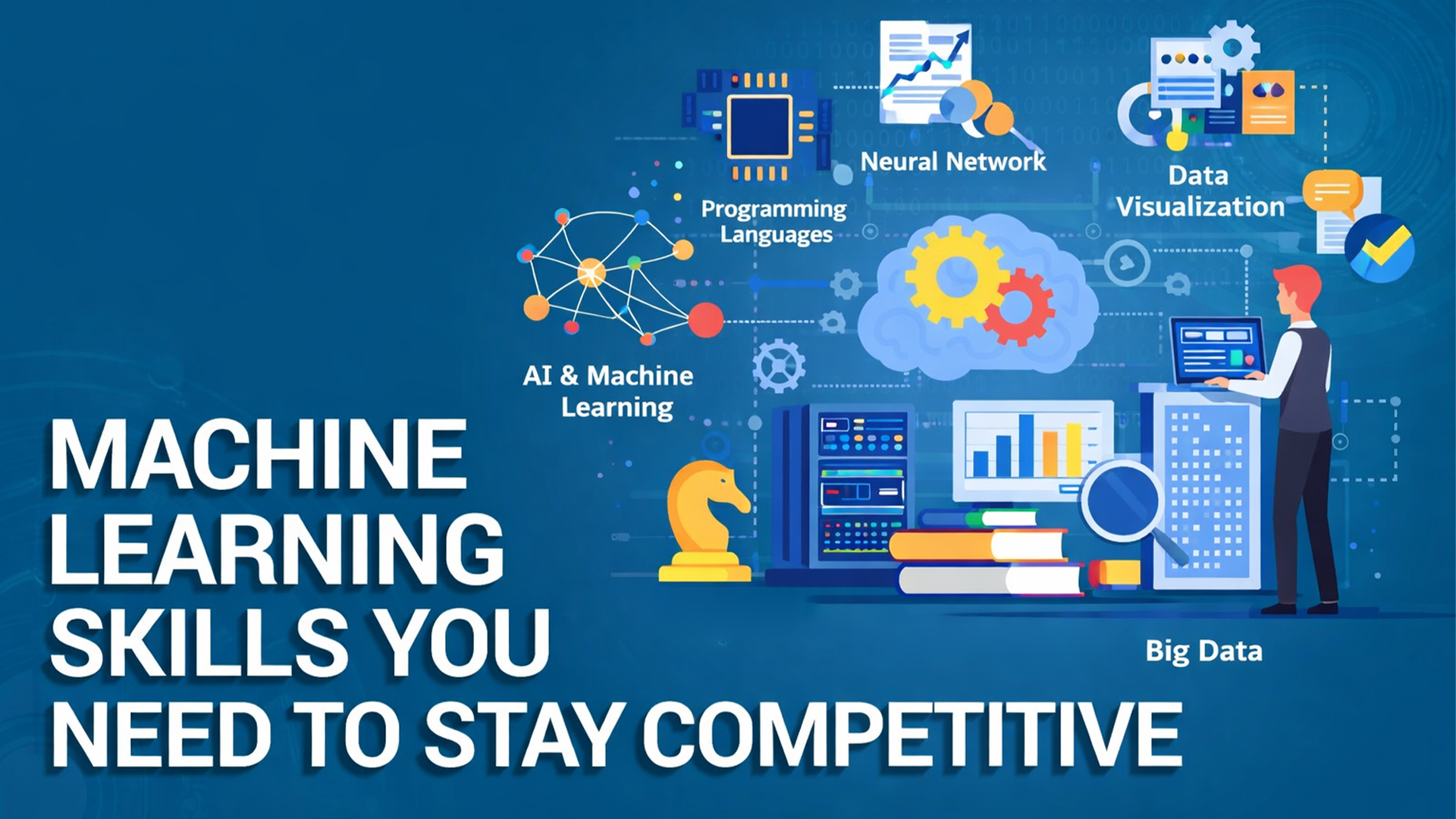
Machine Learning Skills You Need to Stay Competitive are no longer optional in today’s technology-driven world. As artificial intelligence continues to transform industries—from healthcare and finance to marketing and manufacturing—professionals with strong machine learning skills gain a clear competitive advantage. Organizations increasingly rely on data-driven decision-making, automation, and predictive analytics, making machine learning expertise a critical requirement rather than a niche specialization.

Understanding machine learning fundamentals, practical tools, and real-world limitations helps professionals adapt to rapid technological change. This article explores the essential machine learning skills you need to stay competitive, while also highlighting how AI systems like ChatGPT work, where they can fail, and why critical thinking remains an irreplaceable human skill.

Understanding the Nature of AI-Generated Mist and Machine Learning Basics

Machine Learning Skills You Need to Stay Competitive are becoming essential as artificial intelligence continues to transform industries and professional roles. Artificial intelligence systems such as ChatGPT operate on probabilistic pattern recognition rather than conscious reasoning—a core idea explained in machine learning basics. This distinction is crucial when exploring what is machine learning in any machine learning introduction or overview. For an authoritative explanation of machine learning principles, refer to this resource. While responses may appear authoritative and articulate, they are generated through statistical inference aligned with machine learning concepts, not true comprehension.

These mist are rarely random. They often emerge from gaps in training data, contextual misalignment, or subtle prompt misinterpretation, all of which are discussed when studying machine learning algorithms. Recognizing this helps users frame expectations realistically rather than attributing human-like judgment to an automated system trained using supervised learning, unsupervised learning, or reinforcement learning.

Why ChatGPT Can Sound Confident Yet Be Incorrect

One of the most deceptive characteristics of advanced language systems is eloquent certainty—a behavior frequently analyzed in machine learning models and techniques. ChatGPT is optimized for fluency and coherence rather than real-time factual verification, which directly impacts accuracy and optimization outcomes. This can produce responses that sound precise while quietly deviating from accuracy, a challenge often compared in discussions around deep learning vs. machine learning.

The confidence is syntactic, not epistemic. Assertions are constructed to align with linguistic norms produced by machine learning frameworks, even when underlying facts are incomplete or outdated. This phenomenon makes critical evaluation essential, particularly in technical, legal, or scientific contexts where Python for machine learning and related libraries are commonly applied.

Machine Learning Skills

Common Types of Mist in AI Responses

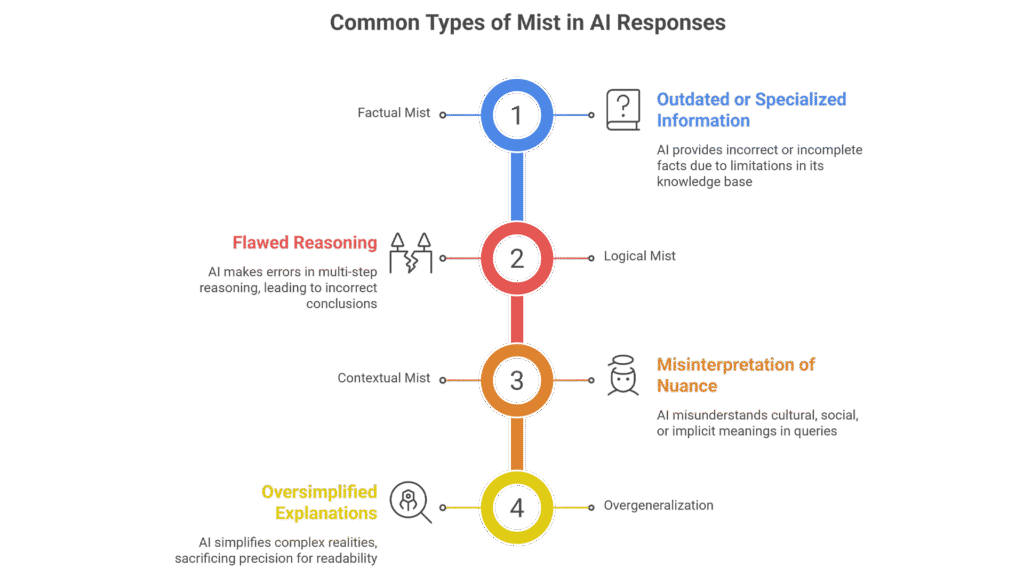
Factual mist often occur when queries require up-to-date or highly specialized information beyond the scope of existing machine learning software. Logical mist may appear in multi-step reasoning tasks, where earlier assumptions cascade into flawed conclusions due to limitations in current tools. Contextual mist arise when nuance, cultural specificity, or implicit intent is misread.

Another frequent category is overgeneralization. The model may flatten complex realities into simplified explanations that sacrifice precision for readability. While useful for beginners or introductory tutorials, this can mislead advanced users if left unchecked—highlighting why strong Machine Learning Skills You Need to Stay Competitive matter.

The Role of Training Data Limitations

ChatGPT’s knowledge is derived from vast but finite datasets, similar to those used in a typical machine learning course or training program. These datasets reflect historical information, dominant narratives, and publicly available content. They do not guarantee completeness, neutrality, or contemporaneity—a known constraint when you learn machine learning online.

Consequently, obscure topics, emerging research, or region-specific details may be represented unevenly. The absence of certain perspectives can subtly skew outputs, producing mist that are difficult to detect without domain expertise gained through structured learning.

Human Input as a Catalyst for Error

Ambiguous prompts, vague questions, or incorrect premises provided by users can significantly increase the likelihood of flawed responses, regardless of how advanced the underlying models may be. When an input contains an assumption, the system often accepts it implicitly rather than challenging its validity.

Precision in questioning is therefore not optional. Well-scoped prompts reduce interpretive latitude and help anchor responses within a more reliable semantic boundary—an essential practice for professionals developing Machine Learning Skills You Need to Stay Competitive.

Mitigating Mist Through Critical Engagement

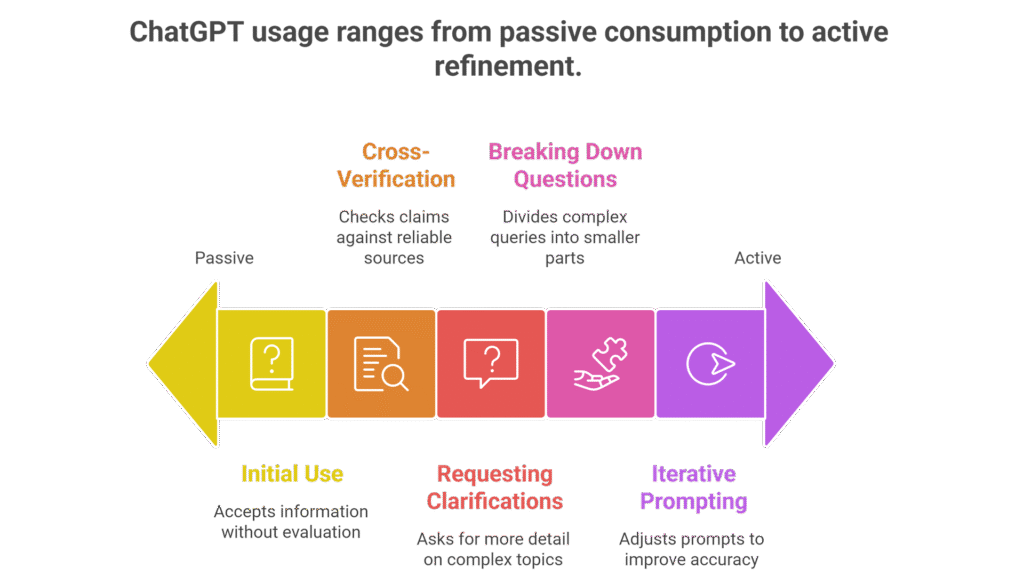
Effective use of ChatGPT requires an active, evaluative mindset similar to professional practice in business environments. Cross-verifying claims with authoritative sources, requesting clarifications, and breaking complex questions into smaller components all contribute to higher-quality outcomes.

Iterative prompting is particularly effective. Refinement exposes inconsistencies and allows the user to steer the response toward greater accuracy and relevance, a habit valued in healthcare, finance, and other high-stakes machine learning applications.

Appropriate Use Cases and Risk Awareness

ChatGPT excels in ideation, drafting, summarization, and explanatory support, aligning with many real-world use cases. It is less reliable as a sole source of truth for high-stakes decision-making. Understanding this boundary prevents misuse and overreliance, especially in regulated domains.

In professional environments, outputs should be treated as preliminary artifacts—useful starting points rather than definitive conclusions—much like exploratory results in early-stage machine learning projects.

The Value of Transparency About AI Fallibility

Acknowledging that ChatGPT can make mist does not diminish its utility. On the contrary, it encourages responsible adoption and supports long-term skills development. Transparency fosters trust, not by promising infallibility, but by clarifying limitations relevant to a machine learning career path.

When users approach AI as a collaborative tool rather than an oracle, its strengths become more accessible and its weaknesses more manageable—an insight crucial for aspiring machine learning engineers evaluating job roles and salary expectations.

Conclusion: Informed Use Over Blind Trust

ChatGPT is a powerful linguistic instrument capable of accelerating thinking and communication across diverse applications. Yet it remains an instrument—one that requires discernment, contextual awareness, and human judgment.

Mist are not failures; they are signals. Signals that remind users to engage critically, verify diligently, and apply intelligence where artificial systems cannot. By building Machine Learning Skills You Need to Stay Competitive, professionals ensure long-term relevance and responsible AI usage in an increasingly automated world.

Why are machine learning skills essential today?

Machine learning skills are critical as AI transforms industries like healthcare, finance, marketing, and manufacturing. Professionals who understand ML fundamentals, tools, and limitations can leverage data-driven insights, automation, and predictive analytics to stay competitive

How does training data affect AI accuracy?

AI models like ChatGPT are trained on large but finite datasets, which may contain gaps, biases, or outdated information. This can lead to errors in niche, emerging, or region-specific topics.

How do machine learning skills improve professional relevance?

Understanding ML allows professionals to interpret AI outputs critically, design better models, implement automation safely, and stay adaptable in fast-changing industries.

READ MORE
Cloud And DevopsVNetAdminJanuary 27, 2026
Share article:TwitterFacebookPinterestLinkedin
103 Views
8 Likes

Cloud and DevOps Best Practices for Teams

Cloud and DevOps Best Practices for Teams define how modern organizations achieve speed, resilience, and continuous delivery in a cloud-driven era.

Table of Contents

  • Introduction: Evolving Teams for a Cloud-Driven Era
  • Understanding the Foundations of Cloud and DevOps Best Practices
    • Building a High-Performance Cloud DevOps Culture
      • Establishing a Shared Responsibility Model in Cloud DevOps
        • Choosing the Right Cloud Architecture for Team Needs
          • Implementing Infrastructure as Code as a DevOps Best Practice
            • Automating CI/CD Pipelines for Cloud DevOps Teams
              • Version Control Best Practices for Cloud DevOps Teams
                • Adopting Containerization to Improve Portability
                  • Leveraging Kubernetes for Scalable Cloud Operations
                    • Enhancing Observability in Cloud DevOps Environments
                      • Incident Management as a DevOps Best Practice
                        • Security Embedded Through DevSecOps Practices
                          • Managing Secrets and Sensitive Configuration Securely
                            • Optimizing Cloud Costs Using DevOps Strategies
                              • Enhancing Collaboration with DevOps Toolchains
                              • Promoting Continuous Learning in Cloud DevOps Teams
                              • Governance and Compliance in Cloud DevOps
                              • Integrating AI and Automation into DevOps Workflows
                              • Measuring Success with DevOps Metrics
                                • Case Studies of Successful Cloud DevOps Teams
                                • Conclusion: Powering High-Velocity Teams Through Cloud and DevOps Excellence

                                Introduction: Evolving Teams for a Cloud-Driven Era

                                Cloud and DevOps Best Practices for Teams have become essential in a cloud-driven era where speed, resilience, and continuous delivery define success. The velocity of digital transformation has reshaped how modern teams operate. Traditional boundaries between development, operations, security, and infrastructure have dissolved, giving way to integrated ecosystems capable of delivering rapid, high-quality innovation.

                                Organizations no longer compete solely on product features—they compete on speed, experience, and resilience. Cloud computing and DevOps methodologies form the backbone of this new operational paradigm. Learn more about cloud and DevOps best practices in our DevOps training guide.. When combined, they enable teams to transcend siloed workflows and build an environment where automation, experimentation, and continuous delivery become the norm.


                                Understanding the Foundations of Cloud and DevOps Best Practices

                                Defining cloud-native principles that empower agility

                                Cloud-native principles encourage teams to build applications that fully leverage the scalability, elasticity, and distributed nature of the cloud. These principles emphasize modular design, stateless services, and dynamic resource allocation. By adopting cloud-native DevOps practices, teams gain the ability to iterate quickly, deploy frequently, and recover gracefully from failures.

                                Core DevOps values: collaboration, automation, and continuous improvement

                                DevOps best practices for teams focus on cultural alignment as much as technical excellence. Collaboration eliminates friction across roles, automation reduces repetitive work and human error, and continuous improvement ensures systems evolve alongside business needs.


                                Cloud and DevOps Best Practices for Teams

                                Building a High-Performance Cloud DevOps Culture

                                Fostering cross-functional collaboration across teams

                                High-performing teams following Cloud and DevOps Best Practices for Teams prioritize open communication. Developers, QA engineers, operations teams, and security professionals collaborate through shared dashboards, stand-ups, and design reviews—accelerating delivery and reducing risk.

                                Creating psychological safety to support experimentation and learning

                                Psychological safety enables experimentation without fear. When teams feel safe to fail and learn, innovation thrives and systems improve continuously. These principles strengthen Cloud and DevOps Best Practices for Teams by improving collaboration, speed, and system reliability.


                                Establishing a Shared Responsibility Model in Cloud DevOps

                                Clarifying ownership across development, operations, and security

                                A shared responsibility model is a core DevOps best practice. Development teams own application logic, operations teams manage performance and uptime, and security teams ensure compliance. Alignment across these roles strengthens reliability.

                                How shared accountability accelerates release cycles

                                When responsibility is shared, handoff delays disappear. This speeds up releases and improves overall system resilience.


                                Choosing the Right Cloud Architecture for Team Needs

                                Monolithic vs. microservices architecture

                                Monolithic systems offer simplicity, while microservices—commonly used in cloud-native DevOps—enable independent deployment and scalability. The right choice depends on team maturity and long-term goals.

                                Cloud-native design patterns for resilience

                                Patterns such as circuit breakers, bulkheads, and service meshes help teams build fault-tolerant systems capable of handling failures gracefully.


                                Implementing Infrastructure as Code as a DevOps Best Practice

                                Why Infrastructure as Code improves consistency

                                Infrastructure as Code (IaC) is a foundational cloud DevOps best practice that eliminates configuration drift, accelerates provisioning, and ensures repeatable environments.To explore this further, read our complete guide on Infrastructure as Code best practices.

                                Best IaC tools for cloud teams

                                Terraform, AWS CloudFormation, Azure Bicep, and Ansible enable teams to manage infrastructure using version-controlled, declarative configurations.


                                Automating CI/CD Pipelines for Cloud DevOps Teams

                                Building a seamless CI/CD workflow

                                CI/CD pipelines automate testing, integration, and deployment—making them a core component of cloud and DevOps best practices for teams.

                                Automation techniques that reduce human error

                                Automated testing, policy checks, and deployment scripts improve reliability and productivity across the software lifecycle.


                                Version Control Best Practices for Cloud DevOps Teams

                                Branching strategies that support continuous integration

                                Trunk-based development, GitFlow, and feature branching help teams collaborate efficiently while maintaining code stability.

                                Maintaining code quality through reviews

                                Structured code reviews promote knowledge sharing and long-term maintainability.


                                Adopting Containerization to Improve Portability

                                How containers support cloud-native DevOps

                                Containers ensure applications run consistently across development, testing, and production environments.

                                Container security and image best practices

                                Using lightweight images, proper tagging, and vulnerability scanning strengthens container security.


                                Leveraging Kubernetes for Scalable Cloud Operations

                                Automated scaling and self-healing infrastructure

                                Kubernetes enables automated scaling, load balancing, and self-healing—key advantages of cloud-native DevOps practices.Kubernetes provides automated scaling and self-healing capabilities, as explained in the official Kubernetes documentation.

                                Optimizing clusters for cost and performance

                                Efficient resource limits and autoscaling reduce costs without sacrificing performance.


                                Enhancing Observability in Cloud DevOps Environments

                                Monitoring performance and system health

                                Real-time dashboards and alerts help teams detect and resolve issues proactively.

                                Logs, metrics, and traces

                                Together, these elements form a complete observability stack essential for modern cloud systems.


                                Incident Management as a DevOps Best Practice

                                Runbooks and on-call strategies

                                Prepared runbooks and effective on-call rotations ensure rapid incident resolution.

                                Blameless post-incident reviews

                                Retrospectives focus on learning and system improvement rather than blame.


                                Security Embedded Through DevSecOps Practices

                                Shifting security left

                                DevSecOps integrates security into every stage of development, reducing late-stage vulnerabilities.

                                Automated security scanning

                                Continuous scanning of code, dependencies, and container images protects cloud environments.


                                Managing Secrets and Sensitive Configuration Securely

                                Secure storage and rotation

                                Secrets managers and encryption protect credentials and sensitive data.

                                Cloud-native security tools

                                AWS Secrets Manager, Azure Key Vault, and HashiCorp Vault enforce access control and auditing.


                                Optimizing Cloud Costs Using DevOps Strategies

                                Rightsizing workloads

                                Analyzing usage patterns helps eliminate wasted resources.

                                Auto-scaling and cost dashboards

                                These tools enable proactive cost optimization without impacting performance.


                                Enhancing Collaboration with DevOps Toolchains

                                Integrated toolchains align communication, deployment, monitoring, and analytics—improving visibility and coordination.


                                Promoting Continuous Learning in Cloud DevOps Teams

                                Upskilling through certifications, workshops, and internal knowledge sharing sustains long-term excellence.


                                Governance and Compliance in Cloud DevOps

                                Automated policies and audit-ready processes ensure compliance without slowing innovation.


                                Integrating AI and Automation into DevOps Workflows

                                AI-driven insights help predict failures, optimize pipelines, and enable self-healing systems.


                                Measuring Success with DevOps Metrics

                                DORA metrics

                                Deployment frequency, lead time, change failure rate, and MTTR validate DevOps maturity, as defined by Google’s DevOps Research and Assessment (DORA).

                                Data-driven improvement

                                Metrics guide targeted optimizations and continuous improvement.


                                Case Studies of Successful Cloud DevOps Teams

                                Organizations adopting cloud and DevOps best practices for teams achieve faster deployments, higher reliability, and lower operational costs.


                                Conclusion: Powering High-Velocity Teams Through Cloud and DevOps Excellence

                                In a rapidly evolving digital landscape, static systems cannot compete. By adopting Cloud and DevOps Best Practices for Teams, organizations enable faster delivery, stronger security, optimized costs, and scalable growth. Embracing cloud-native architecture, DevOps culture, and automation builds a foundation for long-term digital success.Organizations aiming to scale faster can also explore our cloud DevOps implementation guide.

                                READ MORE
                                FullstackPhythonVNetAdminJanuary 22, 2026
                                Share article:TwitterFacebookPinterestLinkedin
                                99 Views
                                8 Likes

                                Top Full Stack Project Ideas for Beginners

                                Table of Contents

                                • Introduction: Why Full Stack Project Ideas for Beginners Matter
                                • How to Choose the Right Full Stack Project Ideas for Beginners
                                • Beginner-Friendly Tech Stacks for Full Stack Project Ideas for Beginners
                                  • Simple Full Stack Project Ideas for Beginners to Build Core Skills
                                  • Intermediate Full Stack Project Ideas for Beginners to Improve Practical Skills
                                  • API-Based Full Stack Project for Beginners
                                  • Full Stack Project Ideas for Beginners to Learn Authentication and Security
                                  • Real-Time Full Stack Project Ideas for Beginners Using WebSockets
                                  • Tips to Build and Showcase Full Stack Project Ideas for Beginners Professionally
                                  • Conclusion: Turning Full Stack Project Ideas for Beginners into Career Opportunities

                                  Introduction: Why Full Stack Project Ideas for Beginners Matter

                                  Full Stack Project Ideas for Beginners are one of the most effective ways to convert theoretical knowledge into real-world development skills. While tutorials often focus on isolated concepts, working on real full stack projects helps beginners understand how frontend, backend, databases, APIs, and deployment work together as a complete system.

                                  Building real-world full stack applications improves logical thinking, problem-solving ability, and architectural understanding. Beginners who consistently practice full stack project ideas for beginners gain the confidence to explore new technologies, debug complex issues, and clearly explain their work during interviews. Employers value such candidates because projects demonstrate practical capability, not just theoretical knowledge.

                                  Starting with simple and scalable beginner full stack projects allows learners to grow step by step without feeling overwhelmed. With structured guidance from training programs like VNET Academy for web development in Coimbatore, beginners can follow an industry-oriented learning path and become job-ready faster.


                                  How to Choose the Right Full Stack Project Ideas for Beginners

                                  Choosing the right full stack project ideas for beginners starts with understanding your current skill level. Projects that are too complex can cause frustration, while overly simple projects may not improve problem-solving skills.

                                  Selecting technologies aligned with learning goals is equally important. For example, React is ideal for modern UI development, while Django or Node.js helps beginners understand backend logic. The best beginner full stack projects balance an easy-to-build frontend with a backend that introduces authentication, databases, and APIs gradually.

                                  Projects that evolve over time—by adding dashboards, user roles, or cloud storage—mirror real-world development cycles. Training programs like VNET Academy for web development in Coimbatore help learners select beginner full stack projects that grow along with their skills.


                                  Full Stack Project Ideas for Beginners

                                  Beginner-Friendly Tech Stacks for Full Stack Project Ideas for Beginners

                                  MERN Stack – Modern Web Applications

                                  MERN (MongoDB, Express, React, Node.js) is one of the most popular choices for full stack project ideas for beginners due to its unified JavaScript ecosystem and strong community support. Beginners can learn more about building modern user interfaces from the React official documentation.

                                  MEAN Stack – Structured Learning Approach

                                  MEAN (MongoDB, Express, Angular, Node.js) is suitable for beginners who prefer structured frameworks and enterprise-style development practices.

                                  Python + Django + React – Clean and Scalable

                                  This combination is excellent for beginner full stack projects because Django simplifies backend development while React handles dynamic frontends efficiently.

                                  Node.js + Express + MySQL – Relational Database Experience

                                  This stack helps beginners learn SQL queries, schema design, and backend logic while building practical full stack applications.


                                  Simple Full Stack Project Ideas for Beginners to Build Core Skills

                                  • Personal Portfolio Website with Admin Panel – Teaches CRUD operations, routing, and authentication.
                                  • Interactive To-Do List App with User Authentication – Introduces state management and secure login systems.
                                  • Notes Taking Application with Cloud Storage Integration – Improves API integration and cloud handling skills.
                                  • Basic Blog Website with Comments and Categories – Covers content management, routing, and backend logic.

                                  These beginner full stack projects focus on building strong fundamentals.


                                  Intermediate Full Stack Project Ideas for Beginners to Improve Practical Skills

                                  • E-commerce Store with Cart and Payment Simulation – Demonstrates state management and checkout logic.
                                  • Social Media Feed Application – Introduces relational data and real-time updates.
                                  • Job Portal Website with Recruiter Dashboard – Teaches file uploads, filters, and role-based access.
                                  • Event Booking Platform with Real-Time Availability – Covers concurrency and live data handling.

                                  API-Based Full Stack Project for Beginners

                                  • Weather Forecast App using OpenWeather API
                                  • Movie Search App using TMDB API
                                  • Crypto Price Tracker Dashboard
                                  • Food Recipe Finder Application

                                  These beginner full stack projects strengthen API handling and asynchronous programming skills.


                                  Full Stack Project Ideas for Beginners

                                  Full Stack Project Ideas for Beginners to Learn Authentication and Security

                                  • User Login and Registration System with JWT
                                  • Password Reset and OTP Verification System
                                  • Role-Based Access Control (RBAC) Dashboard
                                  • Secure File Upload System with Validation

                                  Security-focused beginner full stack projects prepare learners for real-world applications.


                                  Real-Time Full Stack Project Ideas for Beginners Using WebSockets

                                  • Live Chat Application
                                  • Real-Time Notification System
                                  • Live Polling or Scoreboard Application
                                  • Collaborative Text Editor

                                  These advanced beginner full stack projects introduce real-time communication concepts.


                                  Tips to Build and Showcase Full Stack Project Ideas for Beginners Professionally

                                  Document every project clearly on GitHub with structured READMEs and setup instructions. Deploy your beginner full stack projects using platforms like Vercel, Netlify, or Render to make them accessible.Learners looking for guided learning can explore a full stack development course in Coimbatore to gain structured project support.

                                  Adding screenshots, demo videos, and feature explanations improves credibility. During interviews, explaining your technology choices and challenges faced shows strong technical understanding.


                                  Conclusion: Turning Full Stack Project Ideas for Beginners into Career Opportunities

                                  Consistency matters more than complexity. Even simple beginner full stack projects can evolve into advanced applications over time. Each project strengthens architectural thinking, technical confidence, and portfolio quality.

                                  Beginners who continuously practice and refine beginner full stack projects especially with guidance from VNET Academy for web development in Coimbatore, can build industry-ready skills and create strong career opportunities in full stack development.

                                  READ MORE
                                  • 1
                                  • 2
                                  • 3
                                  • …
                                  • 32

                                  Recent Posts

                                  • Why Is Full Stack Development In Demand? | Full Stack Development Course in Coimbatore
                                  • Increase Online Sales Fast: Proven Digital Marketing Tips That Deliver Instant Results
                                  • Powerful Hardware and Networking Skills That Drive Modern IT Systems
                                  • Hardware and Networking Troubleshooting Explained for Faster Issue Resolution – Ultimate Guide
                                  • Machine Learning Secrets Behind Smart Apps and AI

                                  Recent Comments

                                  No comments to show.

                                  Archives

                                  • March 2026
                                  • February 2026
                                  • January 2026
                                  • December 2025
                                  • November 2025
                                  • April 2025
                                  • March 2025
                                  • February 2025
                                  • September 2023
                                  • August 2023
                                  • July 2023
                                  • June 2023
                                  • May 2023
                                  • April 2023
                                  • March 2023
                                  • February 2023
                                  • January 2023

                                  Categories

                                  • Business
                                  • Cloud And Devops
                                  • Digital Marketting
                                  • Education
                                  • Fullstack
                                  • Hardware and Network
                                  • Learning
                                  • Machine Learning
                                  • Phython
                                  • Students
                                  • Uncategorized

                                    Recent Posts
                                    • Why Is Full Stack Development In Demand? | Full Stack Development Course in Coimbatore
                                      Why Is Full Stack Development In Demand? | Full Stack Development Course in Coimbatore
                                      March 9, 2026
                                    • Increase Online Sales Fast: Proven Digital Marketing Tips That Deliver Instant Results
                                      Increase Online Sales Fast: Proven Digital Marketing Tips That Deliver Instant Results
                                      February 26, 2026
                                    • Powerful Hardware and Networking Skills That Drive Modern IT Systems
                                      Powerful Hardware and Networking Skills That Drive Modern IT Systems
                                      February 14, 2026
                                    Categories
                                    • Business1
                                    • Cloud And Devops2
                                    • Digital Marketting2
                                    • Education2
                                    • Fullstack6
                                    • Hardware and Network2
                                    • Learning2
                                    • Machine Learning4
                                    • Phython3
                                    • Students1
                                    • Uncategorized296
                                    Tags
                                    AIandML Back-End Development big data boost ecommerce sales Core Hardware Skills core machine learning data analytics DataScience DeepLearning digital marketing tips django full stack projects education email marketing for sales final year full stack projects Front-End Development Full Stack Developer Course Full Stack Development Full Stack Development Course in Coimbatore Hardware and Networking Careers hardware and networking skills Hardware and Networking Troubleshooting Hardware Troubleshooting how to increase online sales increase online sales fast IT Infrastructure Skills IT Skills in Demand IT Troubleshooting Skills Learn Web Development MachineLearning Machine Learning Skills machine learning smart apps machine learning trends MLProjects Networking Fundamentals Networking Tools and Diagnostics Network Troubleshooting online business growth tips paid ads strategy PythonForML python machine learning secret machine learning social media marketing tips Software Development Training V Net Academy Coimbatore Web Development Career